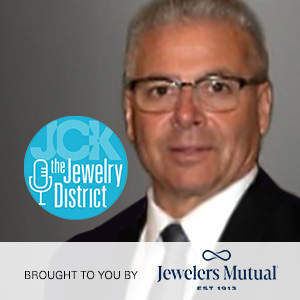
In this week’s episode, JCK editor-in-chief Victoria Gomelsky and news director Rob Bates sit down with Scott Guginsky, executive vice president of the Jewelers’ Security Alliance (JSA), a nonprofit trade association dedicated to battling jewelry crime. Scott, a decorated former NYPD detective sergeant, brings listeners up to speed on the latest high-tech robberies (think Wi-Fi jammers and GPS trackers) and a rash of violent smash-and-grabs that involve ramming cars through storefronts during business hours. Finally, he offers advice on how to protect yourself, your team, and your livelihood. Do: Get insurance. Don’t: Fight back during a robbery.
Listen Now
Sponsor: Jewelers Mutual (jewelersmutual.com/solutions)
Show Notes
2:43 Jewelry crime fighter
6:09 Thieves get tech-savvy
11:43 Don’t be distracted
13:24 Rise in violent robberies
16:55 Safety strategies
18:19 Train your team
19:28 Connecting the dots
21:22 Watch your watch
Episode Credits
Hosts: Rob Bates and Victoria Gomelsky
Producer and engineer: Natalie Chomet
Editor: Riley McCaskill
Plugs: @jckmagazine; jewelersmutual.com/solutions
Show Recap
Jewelry crime fighter
Victoria and Rob welcome guest Scott Guginsky, executive vice president of the Jewelers’ Security Alliance and 24-year veteran of the New York City Police Department.
Scott studied criminal justice in college and joined the NYPD at 21. He spent 18 years as a sergeant and retired as a detective sergeant. While with the NYPD, he created the Organized Theft Squad, a 12-detective team focused on jewelry crime and organized retail theft.
The squad developed deep expertise in smash-and-grabs, homicides, and violent robberies related to the jewelry industry, working closely with leaders in the Diamond District and trade organizations like GIA. Scott took part in GIA’s first-ever training course to help members of the law enforcement community stop jewelry crime in 2008. His team also built a network of task forces throughout the United States to combat jewelry crime. In 2003, he was awarded the James B. White Award for law enforcement above and beyond for jewelry crime.
Thieves get tech-savvy
Victoria asks how jewelry crime has changed since Scott began his career. “Back in the ’80s and ’90s, the most violent crime you could see was the homicide of a jeweler. Back [then] you might have seen 20-something jewelers killed” in a year, he says. He attributes the drop in fatalities to increased awareness and better education for both industry members and law enforcement. Many jewelers now take preventive measures like hiring armed guards and installing door buzzers. Jewelry sales reps, long a target of Colombian gangs, travel far less often with expensive product, so crimes against them have also decreased, according to Scott.
Though homicides are rare nowadays, jewelry crime has become more sophisticated. Tech-savvy thieves use Wi-Fi jammers to bypass alarm systems and secondary cellular backup systems. They put GPS trackers on jewelers’ cars to know when owners leave their stores, and install hunting cameras in front of jewelers’ houses to gauge the best time for a home invasion. Once they know a residence or store is deserted, they cut holes in roofs, walls, or back doors, then spend hours torching a safe or cutting one open with an angle grinder. About 98% of today’s high-tech, Ocean’s Eleven–style burglaries are committed by organized groups from Chile, Scott says.
More alarming is a recent rise in brazen, large-group smash-and-grabs, often using cars to crash into storefronts. There’s a “level of violence on some of these crimes that I’ve never seen in 30-something years,” says Scott. “Now we have groups of 50…that storm a jewelry store or drive a truck through” the facade. With the high price of gold, it’s hardly surprising that dealers and jewelry stores specializing in the precious metal are in the crosshairs.
Don’t be distracted
Distraction crimes, often orchestrated by Romanian gangs, are another risk for retailers, Scott warns. “The distraction crews that we’re seeing from Romania [will] go into a jewelry store well-dressed, wearing high-end watches,” he says. They often show up just before closing and frequently claim to be from Dubai.
The thieves’ usual M.O. is to claim they want to buy a wedding gift and to flash a lot of cash. They might try to separate staff members and ask to see multiple items at once. The biggest red flag? They insist on boxing and bagging the piece they want to “buy” rather than allowing a salesperson to do it, often claiming they want to wrap it themselves for religious purposes. They might even staple the bag shut.
Meanwhile, unbeknownst to the store’s staff, they remove the watch or jewelry item and pocket it before putting the box in the bag. Next, they explain that they don’t have quite enough cash on hand and need to run to a nearby ATM to get the rest. “Then they never come back,” says Scott. Later, “the jeweler opens the box and the jewelry is gone.”
To avoid falling victim to distraction crimes, never put multiple items on the counter. Show clients one piece at a time and keep a close eye on it. Don’t turn your back while a customer has access to a piece of jewelry. Finally, inspect each item as you put it back in the showcase to make sure no stones are missing and that it hasn’t been replaced with a fake.
Rise in violent robberies
Rob asks for more detail about the rash of attacks on gold jewelers in California. Since March, JSA has tracked 25 violent robberies in the state, all targeting stores because they sell gold, Scott says. “I’ve never seen such a crime wave since I started this 30-something years ago.”
In 13 of the incidents, the robbers rammed stolen cars or pickup trucks through the front of a store in broad daylight while it was open for business. It’s a shocking new level of violence, Scott says. JSA is working closely with local law enforcement and the FBI to catch those responsible and prevent future incidents, he adds.
If barriers or heavy planters make it impossible to drive a car into the shop, they’ll often commit “mob-style robberies” where a large group storms in and overwhelms the staff, Scott says.
California isn’t the only target. He describes a recent attack in Seattle where thieves used hammers to break through the door of a jewelry store and shatter the showcases, then used bear spray and tasers to terrorize the employees.
Safety strategies
What should jewelers do to protect themselves? First and foremost, “make sure you have proper insurance,” Scott advises. Those without it tend to be the ones who get hurt during crimes because they’re afraid their entire livelihood will disappear if they don’t stop a store robbery or if someone takes their bag when they’re traveling. “That’s when they fight back, and that’s when we see disaster. We see people hurt or killed,” Scott warns.
The best thing you can do during a robbery is “never resist,” Scott advises. “Criminals don’t go into stores looking to kill people…. A lot of times when people are hurt or killed or wounded it’s because they fought back. There’s no piece of jewelry that’s worth your life. If somebody comes in with a sledgehammer and tells you to get down, you get down.”
Don’t press a panic button or call the police, he adds. You might escalate an armed robbery to a hostage situation, which can lead to more violence. Instead, let the thieves “do whatever they’re going to do and then exit,” Scott advises. “Then you notify law enforcement after they leave the store. If you do that, for the most part you won’t be hurt.”
Train your team
Make sure your staff knows what to do—and what not to do—during a robbery, Scott says. Some store managers worry that they’ll scare employees away if they mention crime. But “you’re doing an injustice to your employees if you don’t equip them with all the information and all the tools necessary” to stay safe, he explains.
Be aware of the types of crimes happening now and develop response procedures. For example, some stores have code words a salesperson can use if there’s a problem at a counter, so additional staff can come over and provide extra assistance that might discourage a thief posing as a customer. Hold meetings to go over security steps with your employees.
Connecting the dots
Rob asks about JSA’s role in helping law enforcement battle jewelry crime. The association provides a valuable resource for the police and members of the security and intelligence communities at the federal and local levels, Scott says. Even the FBI recognizes JSA’s jewelry industry crime database.
The government has no such database, so even though jewelry crime often crosses state lines, local officials tend to be unaware of similar crimes being committed in other states. JSA can be instrumental in helping them connect the dots.
When jewelry-related crimes occur, “we reach out to police agencies, FBI, ATF, Secret Service, whoever is investigating and give them pattern sheets for all the other jurisdictions,” Scott explains. JSA also provides resources to assist cops in solving jewelry crimes and to provide education on jewelry crime trends, thieves’ behavior patterns, the technology they’re using, and so on.
Watch your watch
Victoria is curious about robberies targeting people wearing luxury watches. Scott says the Miami Beach Police Department recently arrested a crew that was robbing people of high-end watches at gunpoint.
JSA has seen a pattern of watch thieves targeting jewelers too in recent years, he says. He urges jewelers not to leave their stores wearing expensive timepieces, particularly in areas like Manhattan’s Diamond District, L.A.’s Hill Street, and the Seybold Jewelry Building in Miami.
Be equally mindful when you go to weddings, dressy family events, and black-tie functions in the industry. Thieves can easily monitor your social media accounts and keep track of trade association calendars listing jewelry galas and benefits.
“When word goes out [that] you’re going to a function, you’re a target when you leave your house,” Scott warns. Thieves know the odds are good that you’ll be wearing gems that would normally stay locked in a safe, and they’ll wait outside your home to rob you, he says.
For more information:
If you need help preventing or recovering from a jewelry-related crime, contact JSA at jsa2@jewelerssecurity.org or 212-687-0328. You don’t need to be a member to get advice from the group or to access the website at jewelerssecurity.org.
JSA sends members a weekly bulletin with crime patterns, photos of suspects, red flags to watch for, and advice on how to protect yourself. Members can also sign up for a new text alert program that shares real-time information about suspicious activity and attempted robberies in locations relevant to you.
Any views expressed in this podcast do not reflect the opinion of JCK, its management, or its advertisers.
- Subscribe to the JCK News Daily
- Subscribe to the JCK Special Report
- Follow JCK on Instagram: @jckmagazine
- Follow JCK on X: @jckmagazine
- Follow JCK on Facebook: @jckmagazine