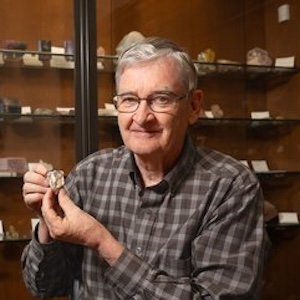
George Rossman, a respected professor of mineralogy at the California Institute of Technology (Caltech) and a longtime member of GIA’s board of governors, died on Feb. 6. He was 81.
“The unifying theme of his research career,” said a Caltech statement, “was a simple, relatable question: Why do gems and other minerals possess their distinctive colors?”
In addition to his university work, Rossman became involved in jewelry industry organizations and was a frequent speaker at gem-oriented symposiums. He served as a member of GIA’s board of governors, from 1995 to 2007, and on the editorial board of GIA’s journal, Gems & Gemology. Rossman cowrote several notable articles for G&G, including an early look at the magnetic qualities of gem-quality synthetic diamonds.
In 2004, when Rossman received a teaching award from Caltech, JCK’s then gemstone editor, Gary Roskin, praised him for helping the publication explain “complicated gemological topics—in an easily understood and practical manner—to the retail jeweler.”
Rossman was born in 1944 in La Crosse, Wis., and spent his childhood in Eau Claire, a nearby lumber town. In a 2020 interview on the web series Mineral Talks Live, he said his love of minerals dated back to grade school.
“Occasionally I would find little teeny crystals of either calcite or quartz, which fascinated me,” he recalled. “Over time, I let it be known to my friends that I had these, and some of friends that were in Illinois started to give me little fluorite cubes from the Rosiclare area of Illinois. And that got me further enamored with minerals.”
Rossman’s interest deepened after the daughter of a next-door neighbor took a college chemistry class, found the subject uninteresting, and gave him her textbooks.
One of the books included “a list of minerals and the chemical formula of minerals,” he said on Mineral Talks. “And I became aware of all the different elements.”
But perhaps the biggest turning point came when Rossman saw his first tourmaline crystal, which he treasured enough that he still had it in his office decades later.
“[I] had what I thought was a rock, that was transparent like a piece of glass, and came in multiple colors,” he said. “I had never seen anything like that before. And that just absolutely fascinated me.
“I asked my teacher to explain: How can it be, that this rock I had was transparent and came in multiple colors? And the teacher didn’t have a clue about this. And that really got my curiosity going about where the color came from. So, combining my interest in chemistry, which I already started to develop, with my interest in minerals, I became absolutely fascinated with the chemical origin of color in minerals.”
Rossman graduated from Wisconsin State University–Eau Claire with a B.S. in chemistry and mathematics in 1966. He received his Ph.D. from Caltech in 1971, and became an assistant professor in mineralogy there after he graduated. He was granted tenure in 1977 and promoted to full professor in 1983.
In his years in academia, Rossman authored nearly 400 papers and received numerous awards.
In 2001, he won the inaugural Dana Medal from the Mineralogical Society of America. Three years later, Caltech awarded him the Feynman Prize, its most prestigious teaching honor, for “exceptional ability, creativity, and innovation in both laboratory and classroom instruction.”
In 1998, the International Mineralogical Association named a new mineral Rossmanite, in recognition of his work on tourmaline-group minerals.
Tom Moses, GIA’s executive vice president and chief laboratory and research officer, tells JCK via email that Rossman “left an indelible legacy at GIA. He brought his expertise, passion for minerals and gems, and dedication to science to his service as a governor. As a leading authority on mineral spectroscopy and the causes of color in minerals, he served as an adviser to GIA’s research efforts for more than 50 years.”
On LinkedIn, Emmanuel Fritsch, a former GIA researcher and frequent collaborator, called Rossman “a mentor to me, an exceptional scientist, and a very fine man. He will be sorely missed.”
(Photo courtesy of Caltech)
- Subscribe to the JCK News Daily
- Subscribe to the JCK Special Report
- Follow JCK on Instagram: @jckmagazine
- Follow JCK on X: @jckmagazine
- Follow JCK on Facebook: @jckmagazine