Of all the competitive threats facing jewelers today, the growth in luxury travel may be the most consequential. While soft luxury categories such as fashion and beauty continue to experience declining sales, fine jewelry and high-end travel remain luxury bright spots.
What do top-tier travel providers understand about the changing needs and desires of high net-worth individuals? Last week, I attended a luxury travel conference in Las Vegas, where speakers from across the industry extolled the surge in demand for high-end travel amenities and deluxe accommodations—and shared insights that would appeal to fine jewelers.
It was my second time at International Media Marketplace Luxury North America—otherwise known as IMM LUX 2026. I came away from the event with a new appreciation for the evolving definition of luxury and what it implies about how retailers should position their products and services.
Todd Handcock, chief commercial officer at Collinson International, a U.K.-based company that owns Priority Pass, a global network of over 1,900 airport lounges, summed it up best during his keynote speech:
“For decades, luxury was relatively easy to recognize: It was more space, more privacy, more visible exclusivity,” Handcock said. “Today, the most valuable elements of luxury can be the least visible. Time recovered, friction removed. The glass of wine that the person in the lounge knows is for you when you walk into the lounge. The calm when the journey becomes uncertain. And really, this starts to create a paradox: At the moment when luxury has become more visible than ever, what makes it feel luxurious is increasingly becoming invisible.”
Below are a handful of insights gleaned from speakers at IMM LUX that apply to fine jewelers, too.
Access, not excess
Nick Wayland, the CEO and founder of TravMedia, the organizer of IMM LUX, kicked off the event with a pithy comment that became something of a refrain over the next two days: “Luxury is not about excess; it’s about access.”
“Access to the place before it becomes a place,” Wayland said. “Access to the person who spent 40 years learning something and will spend hopefully the afternoon teaching it today. Access to a table you could not have bought into. That’s what the modern affluent traveler is paying for—not more, closer. And commercially, that matters because excess is easy to copy. Any competitor with capital could buy a bigger hotel room. Access is simply impossible to copy because it’s about building relationships, local knowledge, and time.”
Luisa Mendoza, founder and CEO of Global Tourism Sports & Entertainment (GTSE), took it a step further: “If everyone can see the entrance you’re walking in through, then you’re walking in through the wrong entrance,” she said. “It’s about special access, exclusivity.”
Anticipation over personalization
During a fireside chat, Christopher Evans, CEO of Collinson International, shared an anecdote about a safari he and his wife recently took that highlighted a shift he said is happening now in the luxury sphere.
“We’re moving away from personalization to anticipation,” Evans said.
He cited the fragmentation that affects many travelers today—so many travel providers, so little time. “The average customer will have probably seven different apps as they travel,” he said. “The opportunity as we move forward is starting to connect all those different touchpoints. I think we’ll see relationships across different partners and sharing information around customers—with the appropriate consent of individuals. And that can lead to that anticipation of knowing what people want with more data points.”
For Evans, the value of anticipating a client’s needs hit home when he and his wife were returning to their lodge, cold and tired, after a safari game drive. “As we walked into the room, someone had the petals on the floor and run a bath,” he recalled. “The bath was piping hot. It was a complete surprise. My wife was blown away. And then her memory and that experience and the emotional connection to the holiday and the end of a holiday was completely different.
“It’s a bath, but to get the timing right at the exact moment makes a massive difference,” he added. “It’s the same with just generally managing personalization with the right product or the right offering at the right time.”
AI is the new intern
Mendoza, of GTSE, offered an interesting perspective on how AI is shaping the world of travel.
“We have to look at AI like a really good intern,” she said. “You can’t trust it all the way. You have to make sure what it says is accurate.”
Used appropriately, Mendoza added, it becomes “a human amplifier. It’s not going to take over what we do and who we are. It’s going to amplify our work. It’s allowing sports tourism, and tourism as a whole, to be stronger. We’re now more connected through AI and technology.”
She concluded by returning to another of the summit’s much-repeated takeaways: “Those experiences—AI can’t do that.”
Can you feel it?
Handcock, of Priority Pass, made a lot of great points during his keynote. Below are three, about the enduring value of great experiences, that stuck out:
“Our most recent research on U.S. affluent travelers has produced three key findings,” he said. “The first one won’t be a surprise to anyone because we’ve talked about it a lot, and that is that experience is displacing possession. Almost three-quarters of our respondents said that they would rather spend on luxury experiences than on luxury products.
“Second was that service is becoming the substance of luxury—79% said that exceptional service trumps an exceptional product.
“And third, simplicity is becoming scarce, and therefore more valuable. Comfort, calm, and peace of mind, traditional markers that we’ve had in luxury, they haven’t disappeared: The hotel suite, the business class or the premium economy seats, the access to a premium lounge—they still matter, but they’re increasingly becoming the infrastructure of luxury, not its ultimate expression. The product creates the setting. The experience is what creates the luxury value.”
I share these quotes not to dishearten jewelers about the future of luxury product sales, but to remind them that a phenomenal product selection won’t make up for an underwhelming—or worse, disappointing—experience at their store.
The power of sports
Is there a local sports team that inspires a loyal fan following? If yes, then start working on a sponsorship pitch asap. Otherwise, you may be leaving money on the table.
“This summer, we saw that the world came together,” Mendoza said. “It’s the power of sports. Sports travel will continue to be the way for the world to unite. Sports tourism is now valued at around $900 billion annually. Over the next eight years, it’s expected to reach $2.3 trillion. It’s the fastest growing sector in the tourism industry because it unites people more than anything else. This summer it felt like one massive sleepover with your cousins.”
She alluded to million-dollar suites at the World Cup final in July, meet-a-player experiences, hot laps with F1 drivers, and other sports-related perks that affluent clients are more than willing to spend money on. “That’s where the big values are at,” she said.
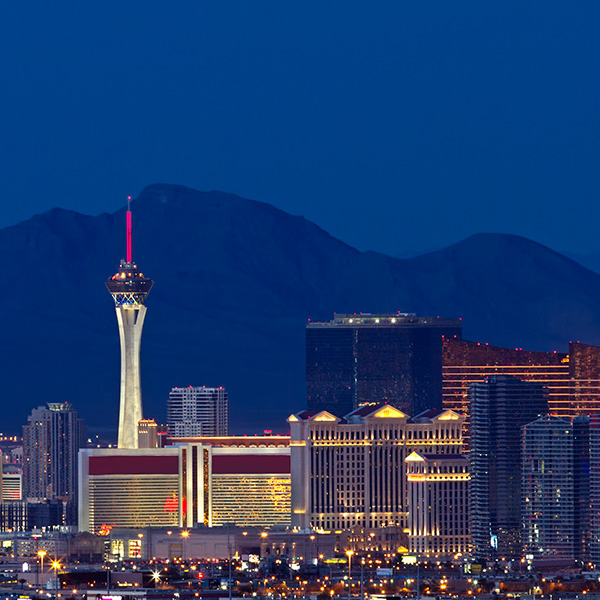
Top: Las Vegas by night (photo: Getty Images)
- Subscribe to the JCK News Daily
- Subscribe to the JCK Special Report
- Follow JCK on Instagram: @jckmagazine
- Follow JCK on X: @jckmagazine
- Follow JCK on Facebook: @jckmagazine