
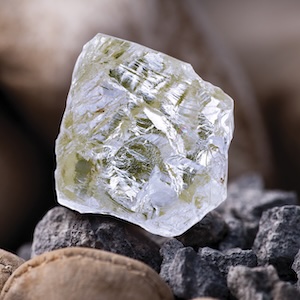
Earlier this month, the Diavik diamond mine in Canada’s Northwest Territories discontinued operations, after producing some 150 million carats over 23 years. Now that the final ore body has been extracted, sorters are looking through it to find the official last stone produced at Diavik.
What will happen to that final gem?
“You’ll have to ask someone more creative than me about that,” Matt Breen, the mine’s chief operating officer, tells JCK. “It will probably take us two or three weeks to clean out the entire system, and then we’ll be able to have a much better idea of what that production actually looks like. God willing, there’s some good diamonds in this last batch. Diavik was famous for its 3- to 4-carat octahedral diamonds, so if we find any, we’ll hold onto them.”
He says any particularly nice-looking stones in that final batch could get displayed at a local museum, or at the offices of miner owner Rio Tinto.
Breen adds that the end of production has left the workers feeling “reflective,” but not necessarily melancholy.
“The teams that are left on-site are very motivated to do well,” he says. “As they’re finishing up, the demolition and the closure team is coming on board, and they’re ramping up and bringing a lot of enthusiasm as well.
“It’s definitely quieter in the dining hall. You don’t have to line up as long for your dinner. But there’s a lot of people who are grateful for their time here, and they’re looking forward to finishing with pride and finishing strong so they can go on to their next job.”
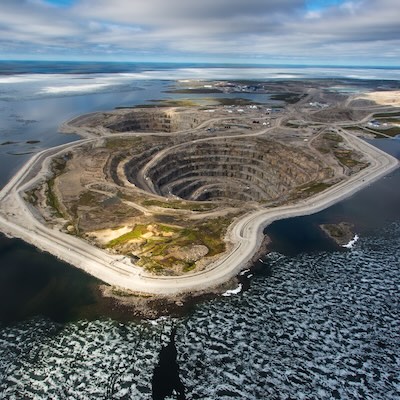
While some have attributed Diavik’s closure to the industry’s current doldrums, Breen says the mine simply reached the end of its life.
“There might be a few more months of production to eke out,” he says. “But one of the challenges of working in the North is you have quite high fixed costs, especially during winter when you’re burning diesel to heat everything. You need an average of 300,000 to 350,000 carats per month just to remain profitable up here. And that just covers your fixed cost and gets you the bare minimum profit margin.”
Despite the current issues in the Canadian diamond sector, Breen believes that eventually there could be new mines in the area but that the added expenses will always be an issue.
“If you’re looking at a fixed cost base for a mine in Africa, for example, certainly labor costs are lower, power costs are lower,” he says. “You don’t have the issue of [building a] winter road.
“The announcement by Prime Minister Carney about the Arctic Economic & Security Corridor certainly gives hope that the deposits that are known to be still up here could one day be developed,” he adds. “Because if there’s a road and there’s power and you’re not incurring those massive fixed costs all at once, there’s a good opportunity for deposits to be developed in a market upturn.”
Asked for a memorable anecdote during his time at Diavik, Breen says, “The entire story of the diamond mine is fascinating—the fact that we had to build a seasonal ice road every year, which then breaks up and falls away to nothing.”
He recalls one instance when a plane headed for the mine crashed, and they needed a rescue team to look for it.
“It was about minus 27 degrees,” he says. “It was blowing a gale. We were talking to the rescue teams about whether they wanted to go find the plane. I said, ‘This is not something we can force you to do.’
“And one of the gentlemen who’s worked here for a long time, who grew up in the North, stood up and said, ‘Matt, for you, it’s cold, it’s dark, it’s windy. You’re looking out there and thinking that’s pretty harsh. For us, it’s Thursday.’ And they went and jumped on their snowmobiles, and they found the plane.”
Breen says the Diavik story is ultimately about people—whether it’s Eira Thomas and her father, Grenville, who discovered the deposit, or the countless workers who battled the area’s difficult weather conditions to build the mine and keep it functioning.
“There’s a real sense of accomplishment as far as making sure we did our best to give back to the North,” Breen says. “Of the 11 billion Canadian dollars we spent running the operation, 8 billion was spent with Northern businesses, and half of that was spent with Northern Indigenous businesses. I think we’ve lived up to what we said we’d do, and we’re going to leave the North with our heads held high.”
Closing the mine will take about four years.
Top: The 187 ct. Foxfire diamond, which was found at Diavik in 2015 (Photos courtesy of Rio Tinto Diamonds)
- Subscribe to the JCK News Daily
- Subscribe to the JCK Special Report
- Follow JCK on Instagram: @jckmagazine
- Follow JCK on X: @jckmagazine
- Follow JCK on Facebook: @jckmagazine