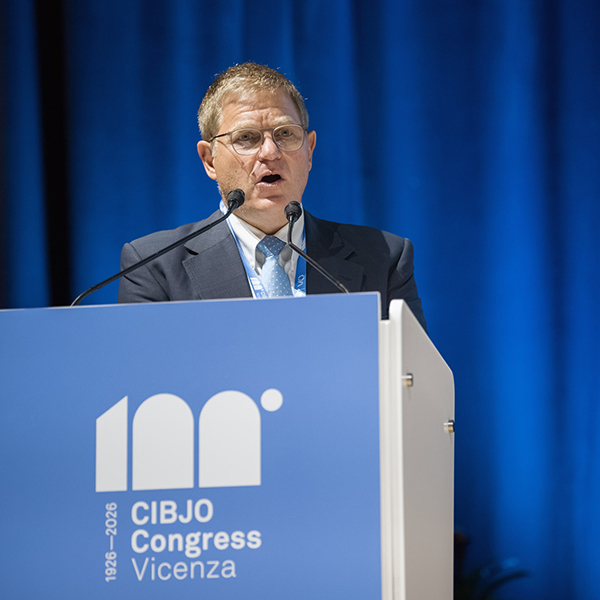
In a speech before the World Jewellery Confederation (CIBJO) on Friday, Sept. 4, Gareth Penny called on the jewelry industry to answer younger consumers’ hard questions about why they should choose natural diamonds.
In an authoritative speech, the former De Beers Group CEO—whose consortium is considered the top contender to buy the diamond giant—asked the audience of CIBJO delegates who came to Vicenza, Italy, for its 100th congress to “sell a dream, or the market will disappear.”
Because the diamond industry is in such flux over the struggle between natural and lab-grown diamonds, Penny said the industry must offer emotional rather than rational arguments for the purchase of natural diamonds in order to ensure their survival into the next century.
“Our industry is in the middle of a real crisis. Natural diamond sales have fallen. Synthetic, or man-made, diamonds have taken the majority by volume of U.S. engagement rings. Consumer trust that all of us may have once taken for granted can no longer be assured,” Penny said. “And I’m not going to stand and tell you the future is rosy. It is not.”
Penny outlined an eight-point approach that could repair what has gone wrong and “put it right,” he said.
“Integrity is not an option. It is foundational,” Penny said. “In the diamond industry, the next century will not be won by companies with the largest mines nor by those with the largest marketing budgets nor by those with the greatest number of retail stores. It will be won, purely and simply, by those that understand and, importantly, earn the confidence of the next generation of consumers.
“And that generation is asking harder questions of all of us in this room than we have ever been asked before: Where did this diamond come from? Who benefited from it? Was the environment respected? Can I trust what you’re telling me? And perhaps most importantly of all: Why should I choose a natural diamond?”
Here are Penny’s eight priorities for natural diamonds and the jewelry industry over the next century:
1. The industry must sell meaning, not minerals.
“We need to sell ideas, not substance,” Penny said. Natural diamonds aren’t valued because of their chemical composition. Rather, they represent life’s greatest moments; they have emotional meaning, and that is their greatest strength. “We are not selling a product. We are selling an idea. We are selling a symbol. We are selling a dream that shows I am loved. Which tells my friends I am successful but does so in an elegant way,” he added. Fail to sell this dream, and the market will disappear. “People do not buy what a luxury product is. They’re not buying the leather or the product or the components. They’re buying what that luxury product says about them.” A good example is the classic three-stone ring, which symbolizes the past, present, and future. The ring’s diamonds could be any size, shape, or color. But they tell a story around natural diamonds based on feeling.
2. The industry must prove natural diamonds change lives.
Responsibly mined natural diamonds create schools, hospitals, roads, infrastructure, and entrepreneurship in countries such as Botswana, Namibia, and Angola. “These colleagues are not just producer companies. They are our partners. And their success is our success,” Penny said. “If consumers only hear criticism, which seems to me what our industry specializes in today, they will assume there is no good story. Our greatest communication failure as an industry has not been what we have done, but it is what we have failed to explain.”
3. Transparency must become an industry standard.
Consumers want to know everything: country of origin, the mine, the cutting journey, environmental information, community investments, the artisans who crafted the jewelry, and the retailer who sold it, Penny noted. Give them a QR code like what’s available through Tracr, and they’ll see evidence that it’s a product to trust rather than just marketing.
4. Sustainability must become visible.
“The diamond industry across the world has invested billions in responsible mining, renewable energy, conservation, water management, biodiversity, and community development. But consumers often know little about these achievements. We need to move from doing good to showing good,” Penny said.
5. The industry must create desire among Gen Y (aka millennials), Gen Z, and Gen Alpha.
“The greatest challenge we face is not a supply challenge. It is a demand challenge,” Penny said. “These generations think differently. They value authenticity, uniqueness, scarcity, and meaning. But we as an industry seem to communicate in yesterday’s language. We emphasize and promote the 4Cs and the Rapaport price list. These don’t create new consumers.” Rather, the natural diamond jewelry business needs to become relevant across milestones rather than just marriage. And the storytelling needs to happen on social media—YouTube, TikTok, Instagram, and the like.
6. The value chain must work as one.
Mining, manufacturing, trading, jewelry design, and retail can’t operate in silos. Consumers see it as one industry—and confidence lost at any point affects every point. The industry needs unprecedented collaboration. “Success needs to be shared because reputation certainly is,” Penny said.
7. Innovation must strengthen tradition.
Innovation is not the opposite of heritage or tradition. Rather, innovation protects it, Penny said. AI will personalize retail experiences. Digital tracking will accompany jewelry throughout its lifetime. Blockchain will strengthen provenance. And immersive technology will transform consumer engagement. “Technology never will replace craftsmanship but it should amplify it.”
8. De Beers must lead the way beyond its own business.
“The current sales process in De Beers marks more than just the change in ownership. It represents an opportunity to renew one of the most influential institutions the global jewelry industry has ever known,” Penny said. “Its influence extended far beyond its market share. The industry now needs De Beers again that once more sees itself and is a successful company and as a steward of the natural diamond category. That means leading in provenance, leading in responsible mining, innovation, consumer information, in collaboration with producer countries.” No single company can build demand alone, but an industry without leadership will struggle to build demand. De Beers can be the catalyst that inspires the industry to collaborate through a shared vision based on partnership.
“The next 100 years will belong to those who embrace meaning over minerals, evidence over assertion, transparency over secrecy, purpose over promotion, consumer understanding rather than industry introspection, collaboration over fragmentation, and innovation to strengthen tradition and not to replace it.”
Top: Gareth Penny addresses the CIBJO audience at its 100th anniversary congress in Vicenza. (Photo courtesy of CIBJO)
- Subscribe to the JCK News Daily
- Subscribe to the JCK Special Report
- Follow JCK on Instagram: @jckmagazine
- Follow JCK on X: @jckmagazine
- Follow JCK on Facebook: @jckmagazine