Men’s jewelry has been heralded as a growth category for years now, with designers and retailers increasingly looking for ways to reach a customer whose options once seemed largely limited to wedding bands, watches, cufflinks, and the occasional chain.
Perhaps the question isn’t how to persuade men to wear more jewelry, but instead how to make jewelry they actually want to wear.
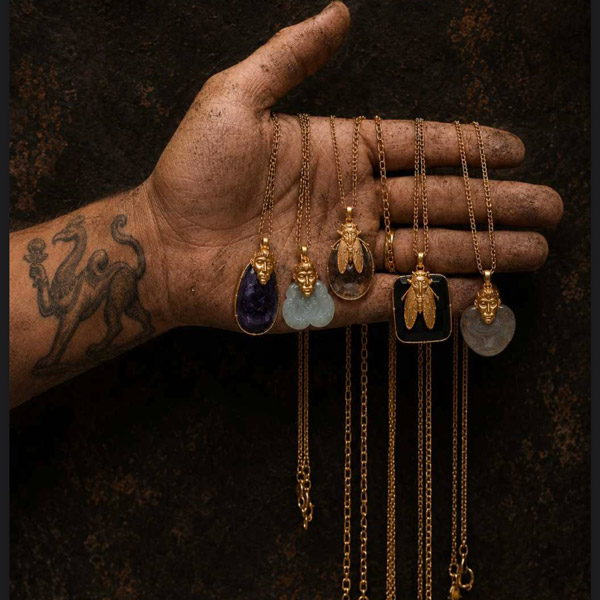
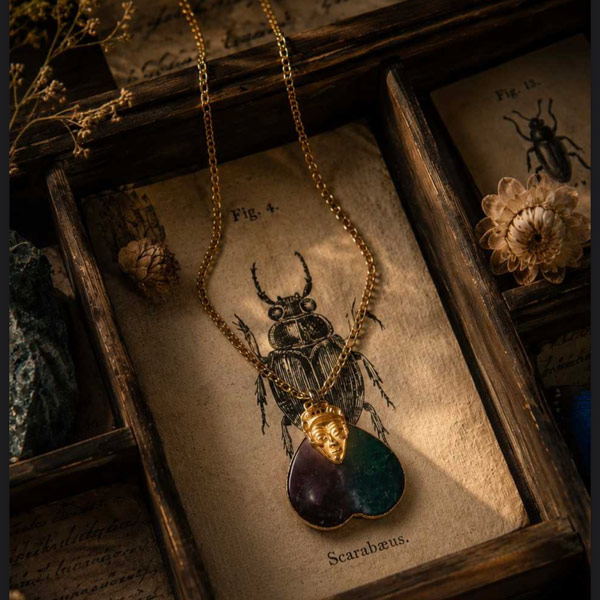
That’s one of the ideas behind Found Objects, the first men’s jewelry line from Puneet Gupta. The fashion collection comprises sculptural pieces intended to feel less like conventional men’s jewelry and more like objects one might have discovered somewhere along the way.
For founder and designer Puneet Gupta, the collection had been percolating for some time. What ultimately made the timing feel right was a change he observed in men’s relationships with objects themselves.
“Men today are far more interested in design, craftsmanship, and personal expression than they were even a decade ago,” Gupta says. “Jewelry is no longer restricted to wedding rings, religious symbols, or occasional dressing.”
Still, much of what he saw in the men’s jewelry market seemed to operate within a fairly narrow design vocabulary—either minimal and commercial or deliberately, emphatically masculine.
“There was an opportunity to create something more nuanced,” he says.
With Found Objects, that meant looking back to create something new.
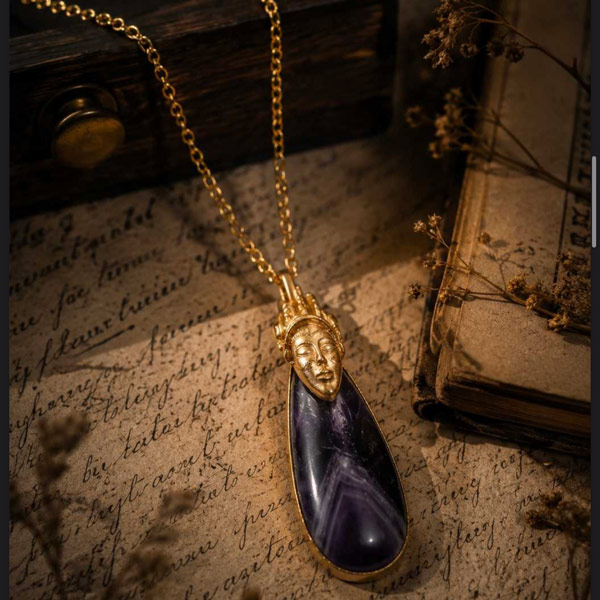
Archaeology, anthropology, mineralogy, and traditional Indian craftsmanship might initially seem like disparate sources of inspiration, but Gupta sees a common thread among them: the human relationship with objects.
“Archaeology tells us what civilizations chose to preserve. Anthropology tells us why humans adorn themselves and give meaning to objects. Mineralogy brings in the forms, textures, and imperfections created by nature itself,” he says. “And Indian craft traditions show us the extraordinary relationship between the human hand, material, and culture.”
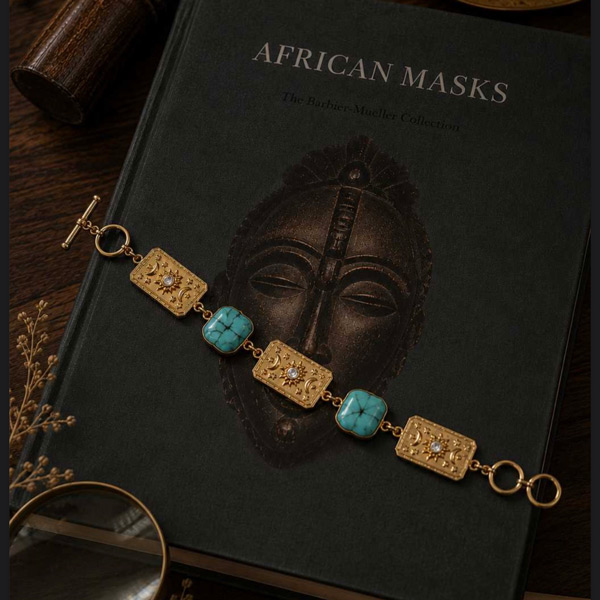
Rather than reproduce artifacts, Gupta pulls individual elements from them—a proportion, a marking, an irregular edge, an aged surface—and reinterprets said elements through a contemporary lens. Geological textures meet ancient-looking markings and architectural geometry; pieces may appear as though they’ve been unearthed, but their histories are entirely dreamed up.
“The past is used as a point of departure, not as a template,” Gupta says. “I want someone to look at a piece and feel that it has a history, even though that history has been imagined.”
That distinction also allows Gupta to sidestep some of the traditional conventions of men’s jewelry.
“I don’t think masculinity in jewelry needs to be defined by weight, scale, darkness, or rigid geometry,” he says. “Those are visual conventions, not necessarily expressions of masculinity.”
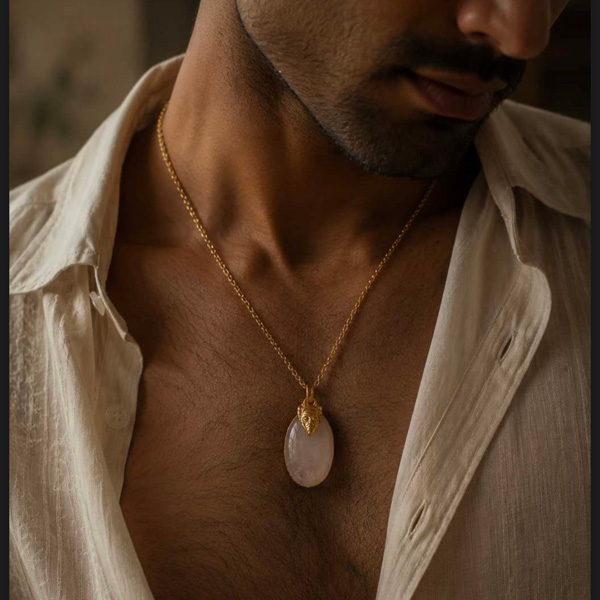
Instead, Gupta describes contemporary masculine jewelry in terms of confidence and individuality. It can be sculptural or delicate, understated or eccentric. And while Found Objects incorporates strong forms, architectural proportions, permanence, and talismanic symbolism, Gupta says there was one convention he particularly wanted to leave behind: “the idea that men’s jewelry has to constantly prove that it is masculine.”
For retailers still figuring out how to approach the men’s category, that distinction may be worth considering.
Gupta believes stores sometimes make the mistake of assuming men need jewelry explained through familiar categories—rings, chains, bracelets, cufflinks—when the contemporary male shopper may respond to the design before he considers what category it belongs to.
And while men may not necessarily want an elaborate narrative attached to every jewel, Gupta pushes back against the idea that they aren’t interested in storytelling.
“They respond very strongly to provenance, material, craftsmanship, symbolism, and the idea behind the object,” he says. “A retailer needs to give the customer enough context to discover the piece without making the experience feel instructional. Let the object create the first conversation.”
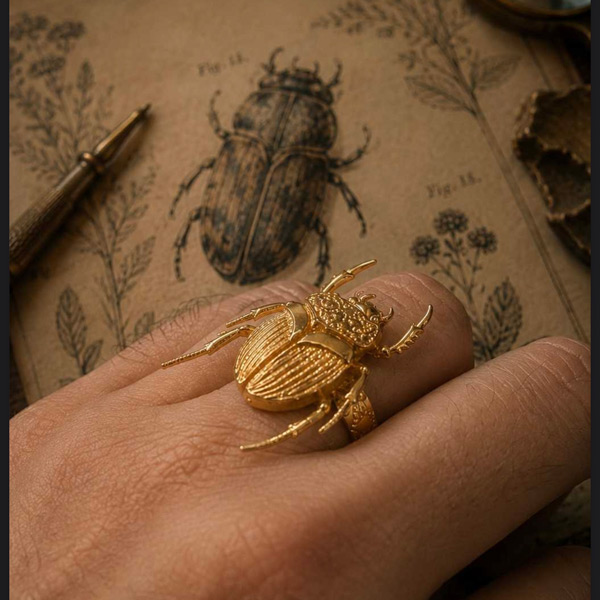
Once a design catches a shopper’s attention, Gupta says, curiosity about its story often follows.
“The purchase usually becomes compelling when there is a combination of design and meaning: I like how this looks, but I also understand why it exists.”
That emphasis on the object itself carries through to the way Found Objects is made.
Rather than applying Indian craft traditions as decorative references, Gupta wanted evidence of the hand to remain visible in the jewelry. Artisans employ traditional knowledge of metalwork, surface treatments, texturing, finishing, and setting within the collection’s contemporary design vocabulary, with some surfaces deliberately worked rather than mechanically perfected.
“In a world where so much is digitally designed and industrially produced, the small variations created by the hand are what give an object its character,” he says.
The approach offers an interesting lesson for jewelers interested in growing their men’s business: Bigger doesn’t necessarily mean better.
“I wouldn’t advise retailers to simply dedicate a large amount of floor space and wait for the category to grow,” Gupta says. “The experience needs to be curated first.”
Instead, he suggests beginning with a smaller, strongly edited assortment and presenting men’s jewelry as a considered world of objects rather than as an afterthought tucked inside a predominantly women’s jewelry store.
“The customer needs to see how the pieces live—with clothing, watches, and other personal objects,” he says. “Once retailers begin treating men’s jewelry as a design category, I think the potential becomes much clearer.”
That doesn’t necessarily mean jewelry itself needs to remain divided neatly by gender. Gupta expects dedicated men’s edits to remain useful for retail navigation and discovery, even as the boundaries around who ultimately wears those pieces continue to loosen.
“The future will increasingly be about aesthetic language rather than gender labels,” he says. “If a piece speaks to you, it should belong to you.”
More broadly, Gupta doesn’t believe the current interest in men’s jewelry is merely another fashion cycle. “Fashion may accelerate the movement, but the underlying change is cultural,” he says.
As men become more comfortable using adornment as a form of identity, Gupta sees jewelry moving into territory already occupied by watches, eyewear, footwear, and collectible objects—things chosen not simply for utility or occasion, but because they contribute to a person’s visual language. And if he’s right, the next stage of growth in men’s jewelry may not simply be about volume.
“Over the next few years, I think we will see men becoming more discerning rather than simply buying more,” Gupta says. “They will look for craftsmanship, provenance, individuality, and pieces that can acquire meaning over time.”
Which brings the conversation back to the question jewelers have been asking: How do you get more men to wear jewelry?
Which might be the wrong question.
“The future of men’s jewelry is not about making men wear more jewelry,” Gupta says. “It is about making jewelry worth wearing—objects with enough character that they become part of someone’s identity and, eventually, part of their story.”
Top: Pendants from Puneet Gupta’s debut men’s jewelry collection, Found Objects, which draws inspiration from archaeology, anthropology, mineralogy, and Indian craft traditions
- Subscribe to the JCK News Daily
- Subscribe to the JCK Special Report
- Follow JCK on Instagram: @jckmagazine
- Follow JCK on X: @jckmagazine
- Follow JCK on Facebook: @jckmagazine