Lean budgets, pressure to convert customers through every possible touchpoint, and limited time and resources can make it difficult for jewelers to decide where to spend their marketing dollars for maximum ROI.
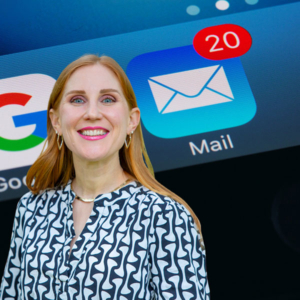
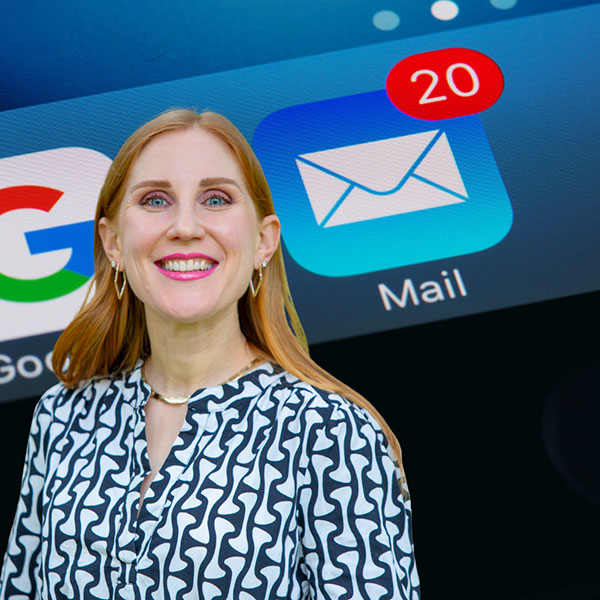
But marketing consultant and podcaster Laryssa Wirstiuk (pictured) says the solution is clear: It’s time to turn your email list into your hardest-working marketing tool.
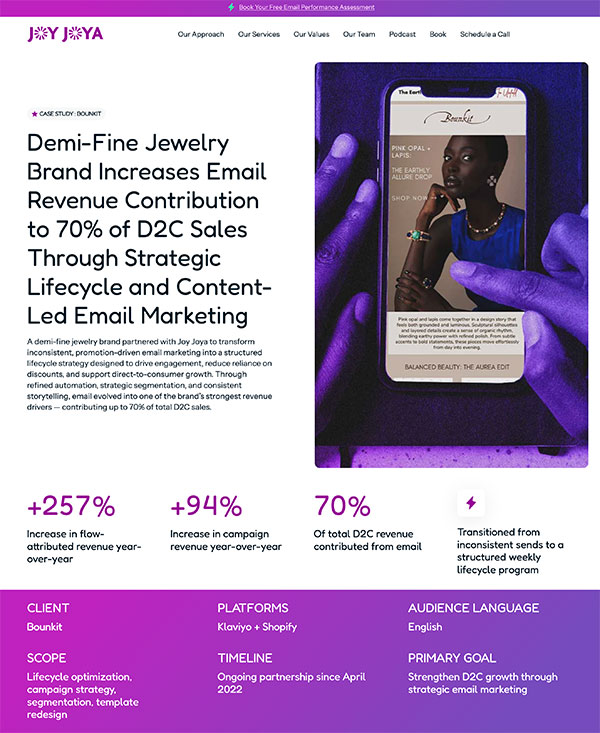
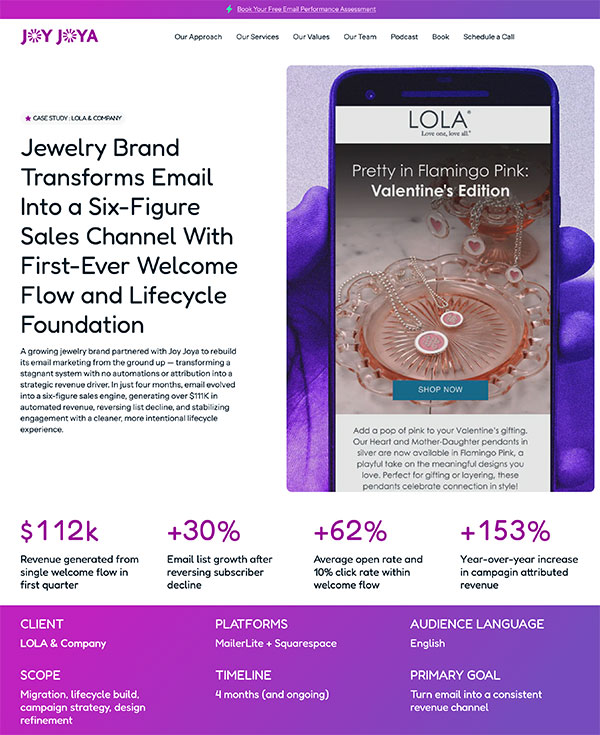
The return on investment could be substantial. “Email marketing has the potential to be driving 30 to 40% of your total e-commerce sales,” says Wirstiuk.
More good news: You can start implementing an email marketing plan with any number of subscribers, even as few as 50 to 100. And if you already have a list going but haven’t been using it? “That’s a gold mine of untapped potential,” she says.
In this Q&A, Wirstiuk makes the case for her recommended approach and shares practical tips for maximizing the impact of this familiar yet often overlooked marketing tactic.
You founded your marketing agency, Joy Joya, in 2016 but recently streamlined your services to primarily focus on email marketing. What prompted that decision?
Up until a year and half to two years ago, we were more of a generalist agency, and email was always part of the mix. The more time I spent on email, and seeing the results that clients could get in terms of engagement and increased revenue, I started to question why I was even wasting my time on other marketing tactics. And with email, I’m able to prove my value as a marketer by tracking the metrics. Businesses have a lot more control and intentionality with email, because that is your own audience: These are people who have already expressed interest in wanting to hear from you. So it’s about making the most of that potential.
How do the results you secured for clients show that email is the most effective way to engage customers and drive sales? It sounds so old-school…
There are preconceived notions—I wish email wasn’t such an unsexy word. But it’s a way to work with something you already have: an email list that you can keep replenishing and building. And the longer a subscriber is on your list, you’re going to get more and more data about them. You’ll know the products they’ve browsed, what products they’ve purchased, what carts they have abandoned, and how often they engage with you.
You can use that info to personalize your messaging. Email really helps with brand perception and reinforcement, too—when you’re more present in a person’s life, they are inclined to remember you.
What is your recommended timeline for sending emails?
I think once a week is a good place to start. When I say that, I think people feel intimidated—to them, it feels like that’s a lot and that they’re annoying their customers. But it’s not true, and it’s actually better to send more regularly because it reinforces a positive reputation of your brand to email providers like Gmail. If you only send once a quarter, or once every six months, you could end up in spam because Gmail will see you as an inconsistent sender. It’s a counterintuitive concept, but the more often you send—as long as it’s to people who want to be on your list—the healthier your reputation will be as a sender.
What if people get your emails and then unsubscribe?
I think jewelers need to change their mindsets about that if it happens. As long as you are trying to share value, and you’re not a spammer, if people unsubscribe? Good riddance. Because they would actually be holding back your deliverability. You only want people on your list who want to be there, and if they leave, that’s for the best.
Most of the tips and strategies we’re discussing here assume that retailers have an e-commerce arm of their business. Is email marketing still a worthy time and budget investment if sales primarily occur in-store?
We have a couple of clients that are more store-focused, but they do have a pretty engaged list of subscribers who want to hear about in-store events and promotions. It does become slightly harder to track the results because they’re not directly tied to clicks into your website or an online checkout, but do we gather and analyze feedback about customers being prompted to visit the store based on whatever they saw in the email.
What are some proven ways to grow an email subscriber base?
It could be something as simple as a pop-up window with some kind of welcome offer the first time someone clicks into your website. Some people worry that it will be annoying to potential new customers—but pop-ups are so effective. They convert. The data shows that they work. If you have a store, you can collect emails at the point of sale or have some kind special offer that customers can sign up for while they are browsing.
What about purchasing a mailing list—we all get emails from businesses and organizations we did not sign up for, so maybe this kind of thing has become acceptable?
For a jewelry brand, there’s no situation where that’s a good idea—it would actually do you more harm than good, and in some ways cause irreversible damage. I would rather you start with a list of 100 subscribers and then work with that. Otherwise, you’ll end up in spam. And not only that, once you end up in spam, it’s really hard to recover your reputation as a sender.
Let’s say a business has an email list but doesn’t use it and hasn’t updated it in years. What should they do in this situation?
Start communicating with your list ASAP. The longer you’re sitting with a list that you’re not using, the less and less valid it becomes. I was just talking to a jewelry business recently and they said they have 6,000 email addresses but have never emailed them before. Some names they’d had for 12 years. I hated having to tell them that they were pretty much going to need to start from scratch.
Tell me about email marketing platforms and how they can make life easier for brands.
If you’re using Shopify for e-comm, I think Klaviyo is the best email marketing solution. It’s one of the more expensive ones, but it integrates well with Shopify, has the best features, and is the most scalable. There are a lot of opportunities for automation which kind of work hard in the background for you. It’s a way to connect with your customers—a welcome email, an “abandoned cart” email, and all these other touchpoints—that you don’t have to set up manually.
Follow me on Instagram: @aelliott718
- Subscribe to the JCK News Daily
- Subscribe to the JCK Special Report
- Follow JCK on Instagram: @jckmagazine
- Follow JCK on X: @jckmagazine
- Follow JCK on Facebook: @jckmagazine