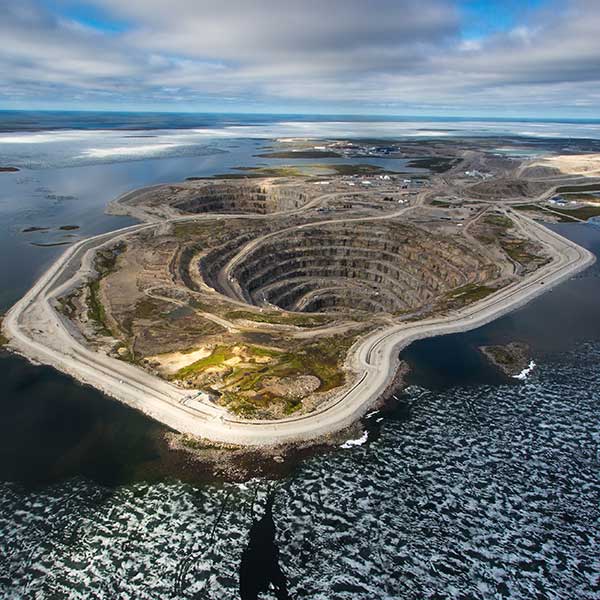
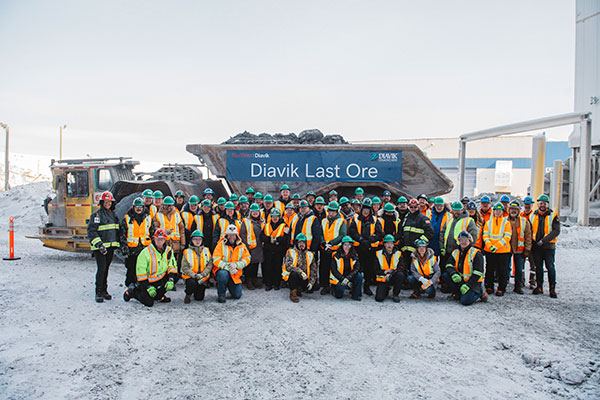
The final day of production at Rio Tinto’s Diavik diamond mine marks the end of an era for North America diamond mining, and the mine’s operation tells an important story of respecting the land and people of Canada, said officials.
Rio Tinto shuttered the mine in Yellowknife, in the Northwest Territories, on March 24, after 23 years of operations and more than 150 million carats of rough diamonds, according to a company statement.
“Diavik has been an inspired collaboration between a modern mining company and Indigenous partners, with an enduring legacy of socioeconomic benefits for the North. We look forward to continuing to respectfully reclaim the land in line with our commitments to, and in partnership with, the government of the Northwest Territories and Indigenous partners,” said Diavik chief operating officer Matthew Breen.
Representatives from Indigenous organizations and the Canadian government attended a closing event honoring the formal completion of production at Diavik. The mine, discovered in 1991 below Lac de Gras (about 135 miles south of the Arctic Circle), began operations in 2003 using both open pit and underground mining methods.
Diavik mostly produced white diamonds, but a few significant yellow diamonds were also found there. Rio Tinto said Diavik’s final rough diamonds will be polished and sold by its international network of customers, including long-standing partner Select Diamantaires.
To fully close the mine, Rio Tinto will continue to supervise key areas such as safety, land use, water, and biodiversity in the area. It also said it will monitor the mine area for a while post-closure.
“Forty years ago, there were very few people who believed there were diamonds in Canada—even fewer could have foreseen how many the Diavik story would unfold,” said Sophie Bergeron, managing director for iron, titanium, and diamonds at Rio Tinto, in a statement.
“To arrive at this milestone has required vision, courage, and determination to overcome significant challenges to mine diamonds beneath a frozen lake in one of the world’s most remove and pristine ecosystems,” she said.
Top: The Diavik diamond mine in Yellowknife, Canada (photos courtesy of Rio Tinto)
- Subscribe to the JCK News Daily
- Subscribe to the JCK Special Report
- Follow JCK on Instagram: @jckmagazine
- Follow JCK on X: @jckmagazine
- Follow JCK on Facebook: @jckmagazine