
At the 2023 JCK Las Vegas show, De Beers introduced the fine jewelry industry to Tracr. Founded in 2018, the blockchain platform uses high-speed photography to create a digital twin of a rough diamond, enabling a new standard of traceability. The mining giant promoted the technology as the backbone of its consumer-facing Origin suite of services, offered through the De Beers Institute of Diamonds, a company division that provides grading, training, and educational services to the trade.
Now, Grandview Klein Diamonds, a diamond manufacturer that has partnered with De Beers to bring the Origin experience to retailers around the country, is poised to introduce the program to a wider swath of the high-end jewelry community at Luxury, which opens May 27.
Last August, Grandview Klein gathered roughly 15 high-end retailers—many of them authorized dealers for Rolex and Patek Philippe, including J.R. Dunn in South Florida, London Jewelers on Long Island, and Razny Jewelers in Chicago—to preview the Origin program.
“We’re trying to sell diamonds a completely different way,” says Moshe Klein, president of Grandview Klein Diamonds. “It’s no longer about price. That’s the only way the diamond industry will survive. And it’s why we picked Rolex and Patek dealers mostly—because they’re used to selling branded products. With a branded product, you don’t talk about price. Price is the last discussion.”
The program, Klein notes, is retailer-focused by design—and built around the counter experience. “It gives the customer a really cool experience about the diamond—everything from how many billions of years old it is, which part of the mine it was found in, how deep it was found, what year it was found, which country it came from,” he says. “Then we talk about how unique every diamond is.”
To qualify for Grandview Klein’s program, polished diamonds must weigh 30 points or more and must have been sourced from De Beers Group mines in Botswana, Namibia, or South Africa—the three countries where Grandview Klein maintains cutting facilities.
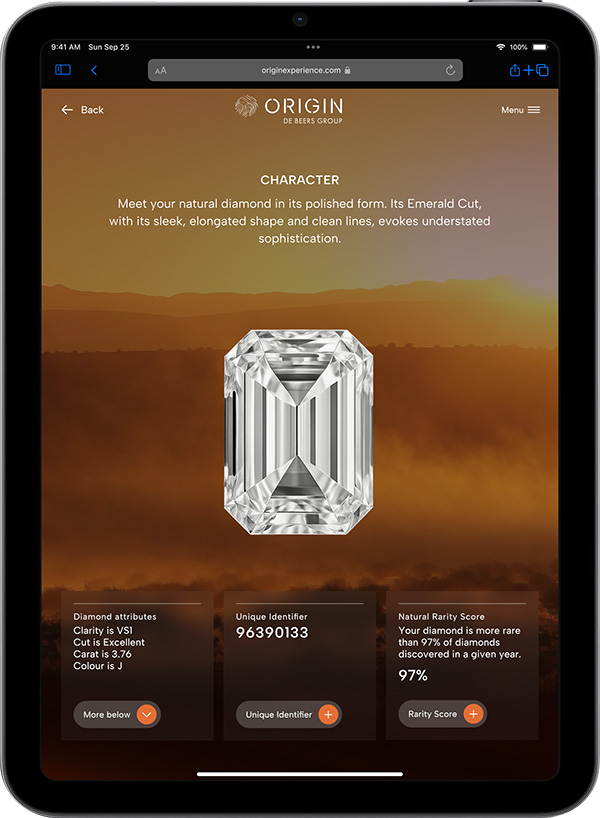
Each Origin diamond comes with a QR code that gives consumers access to a wealth of information well beyond the 4Cs. In addition to basics like carat weight and color, customers learn about their stone’s symmetry; its “birthmarks,” or minute crystals that affect clarity; and its rarity score. They also learn where the diamond was mined, how old it is, and the community impact of their purchase.
“Customers will have videos of the cutters talking about how it impacted them personally—for their lives, for their job, for their family,” Klein says. “It’s something fresh at the counter. When they see it, nobody’s asking, ‘How much is it?’ They’re like, ‘Wow, I didn’t know how rare diamonds were.’ It’s telling the story of the diamond the way it’s supposed to be told. With lab diamonds and everything else going on right now, this is a very nice differentiator.”
Klein is careful to note that Origin is not a brand. “We don’t want to dictate to the retailer, ‘You have to do this, you have to do that.’ We want this to be an ingredient for the brand of the store.”
The program, he says, is deliberately flexible, especially when it comes to the way the stones are set and marketed (via a robust co-op program, he adds).
“We give retailers complete freedom to do however they see fit, because they know their market and their customer better than I or De Beers ever will,” Klein says. “We’re just arming them with the right tools and the right story—the story today’s consumer wants when they buy a car, a Chanel bag, or a timepiece at Rolex or Patek. They’re used to this.”
Top: Origin diamonds by Grandview Klein (photo courtesy of Grandview Klein Diamonds)
- Subscribe to the JCK News Daily
- Subscribe to the JCK Special Report
- Follow JCK on Instagram: @jckmagazine
- Follow JCK on X: @jckmagazine
- Follow JCK on Facebook: @jckmagazine