If you’ve never heard of the Ocean Dream, it’s not surprising: the stone has spent most of its existence in near-total obscurity, surfacing publicly only twice in its entire history. That’s about to change.
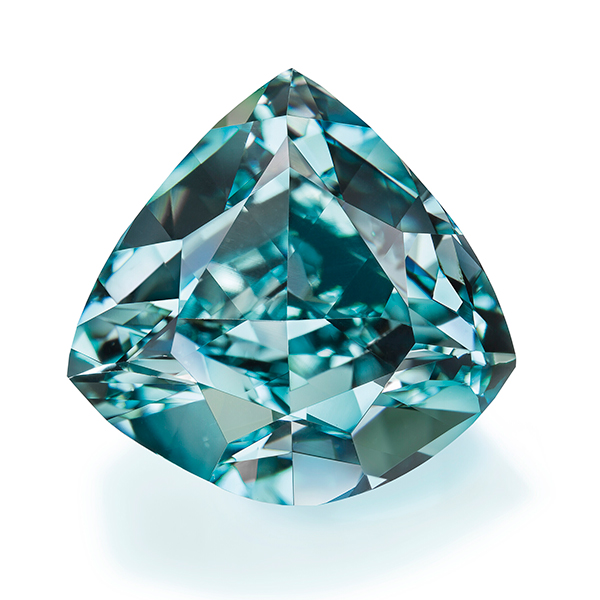
Christie’s Geneva will offer the 5.5 ct. fancy vivid blue-green diamond on May 13 during its Magnificent Jewels sale at the Four Seasons Hotel des Bergues, with an estimate of CHF 7 million–10 million (approximately $8.85 million–$12.5 million).
It is, by any measure, a singular stone. When the Ocean Dream first entered public consciousness in 2003, it was as part of the Smithsonian Institution’s landmark “Splendor of Diamonds” exhibition in the Harry Winston Gallery—an assembly of seven of the world’s most extraordinary diamonds, representing a full chromatic spectrum in one room. The Ocean Dream, described at the time as the largest blue-green diamond known to exist, held its own.
What makes the stone so unusual is its color. The blue-green hue in diamonds is typically caused by exposure to natural radiation, which produces color centers in the crystal structure. Most natural green diamonds exhibit color only on the outer layer, because alpha and beta radiation lacks the penetrating power to affect more than the surface. To achieve saturated blue-green body color all the way through, as the Ocean Dream does, the stone would have needed exposure to high-energy gamma or neutron radiation over millions of years—and it would have had to stay cold the whole time, lest the color centers be erased by heat. The GIA, after exhaustive evaluation, confirmed the color as entirely natural.
At the time of the Smithsonian exhibition, the GIA graded the Ocean Dream as fancy deep blue-green. When the stone was re-examined ahead of its 2014 auction appearance, the institute upgraded its classification to fancy vivid blue-green—the highest saturation grade in GIA’s colored diamond grading system.
The diamond is triangular cut, fashioned from an 11.7 ct. rough found in Central Africa in the 1990s, and it is type Ia—among the purest naturally occurring diamond types. Its second auction appearance at Christie’s will be the first time the stone has crossed the block since May 2014, when a buyer paid CHF 7.7 million ($9.75 million), at the low end of its presale estimate. The anonymous buyer then held the stone for the next dozen years.
Previews are scheduled in Bangkok, Hong Kong, and Geneva ahead of the sale.
(Photo © Christie’s Ltd. 2026)
Follow me on Instagram: @anniedavidsonwatson
- Subscribe to the JCK News Daily
- Subscribe to the JCK Special Report
- Follow JCK on Instagram: @jckmagazine
- Follow JCK on X: @jckmagazine
- Follow JCK on Facebook: @jckmagazine