Charles & Colvard, which for years was the exclusive manufacturer and marketer of moissanite, filed for Chapter 11 on March 2.
“After thoroughly evaluating our alternatives and considering recent events and the market pressures facing our industry, the company’s board of directors decided that a court-supervised process is the best path forward to make the changes needed to ensure Charles & Colvard’s long-term success,” executive board chair Michael R. Levin said in a press release.
Charles & Colvard’s Chapter 11 petition, filed in federal bankruptcy court for the Eastern District of North Carolina, lists $19.2 million in total assets and $10.5 million in debts.
In a declaration filed March 3 with the court, Levin said the Research Triangle Park, N.C.–based company’s business was hurt by the lab diamond boom—somewhat ironic for a company that was arguably ahead of the curve in recognizing the potential of lab-grown gemstones.
“The market has seen a steep increase in consumer demand for lab-grown diamonds and gemstones,” Levin wrote. “However, increasing saturation in the market of companies producing lab-grown diamonds and gemstones continues to drive down the value of these gems. Our company has seen increasing competition in e-commerce for consumer fine jewelry (Blue Nile, Brilliant Earth, others).
“In recent years, there has been a dramatic decline in prices for moissanite and lab-grown diamond gemstones, relative to our investment in moissanite inventory. This has been coupled with a significant increase in prices for precious metals, which we use in settings for finished jewelry.”
Levin said that “inflation, economic headwinds, and an evolving competitive landscape have [also] negatively impacted the jewelry and gemstone industry in recent years.”
He added that Charles & Colvard has faced numerous other challenges in recent years, including its 2025 delisting from Nasdaq, a proxy battle with activist investor Riverstyx Fund (with whom Levin was affiliated), and legal fights with lender Ethara Capital and primary supplier Wolfspeed (which entered, and exited, Chapter 11 last year).
Charles & Colvard’s revenue for fiscal 2025 was $16 million, down from the prior year’s $22 million—and a big drop from its all-time record of $43.1 million. set in 2022, during the pandemic jewelry boom. As sales have fallen, so have profits, and the company has posted losses every year since 2023.
It currently has 25 full-time employees and one part-time employee. Charles & Colvard has not had a CEO since Don O’Connell left in January.
Founded in 1995 as C3, the company went public in 1997 and changed its name to Charles & Colvard two years later. Since then, it’s seen frequent shifts of strategy.
Originally a wholesale dealer, the company veered toward direct-to-consumer, eventually launching a “home party” business, which it ended up unloading about five years later. After its exclusive moissanite patent ran out in 2015, Charles & Colvard introduced a new “colorless” form of moissanite, called Forever One (now graded by IGI).
When lab-grown diamonds exploded, the company introduced its own lab-grown line, called Caydia—though once prices cooled down, it decided to reemphasize moissanite. Then, late last year, after receiving a loan from Ethara Capital (an investment fund associated with Bhanderi Lab Grown), Charles & Colvard said it was pivoting back to LGDs.
Levin’s court declaration does not include much detail on the company’s potential future direction. In the press release, Levin said that “as this process unfolds, the company remains fully committed to serving its customers, supporting its partners, and preserving the value of its brand.”
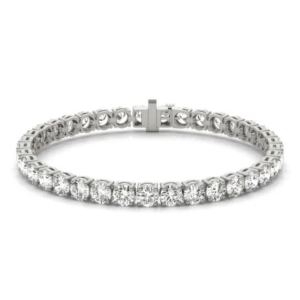
Top: Charles & Colvard moissanite tennis bracelet (photo courtesy of Charles & Colvard)
- Subscribe to the JCK News Daily
- Subscribe to the JCK Special Report
- Follow JCK on Instagram: @jckmagazine
- Follow JCK on X: @jckmagazine
- Follow JCK on Facebook: @jckmagazine