There are certain designers you encounter and immediately you know they’re going to be a gold mine for interesting jewels. Sanct Desiderata founder Julia De Souza is one of them. I first met De Souza in Las Vegas earlier this year, where she was exhibiting as part of Couture’s mentorship program. Her showcase was populated with faces—odd, expressive, wonderfully imperfect faces rendered in pearls, gold, gemstones, and whatever else seemed to suit their personalities. I was hooked.
Her work had humor and weirdness, but also real feeling behind it; even the strangest pieces seemed to have something to say. So when her Gravity lariat fell in front of me last week—a sterling silver necklace inspired by, of all things, a wrecking ball—I wasn’t exactly surprised. But I was, once again, hooked.
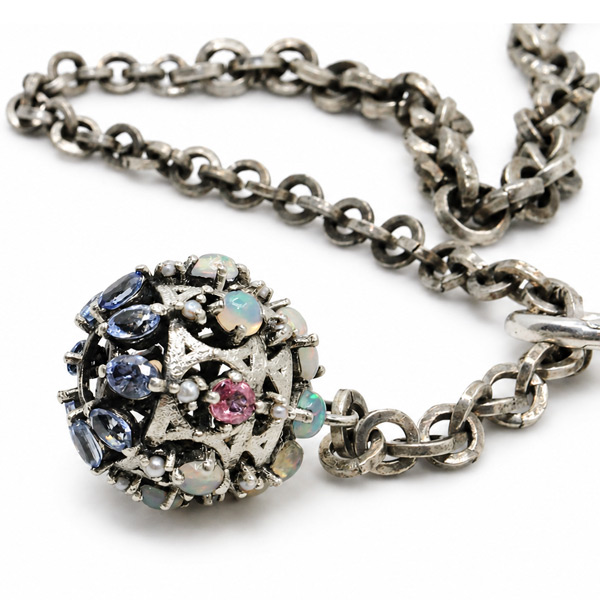
The jewel takes an object associated with weight, force, and destruction and turns it into something intimate: a substantial silver lariat swinging with a 20 mm sphere scattered with opals, sapphires, and tiny seed pearls. It’s brutal and delicate at once, which is precisely where De Souza likes to operate.
The name Gravity goes deeper than the obvious visual reference.
“Gravity becomes more tangible when something has weight, when you can physically feel that pull against the body,” De Souza says. “Gravity itself is invisible, but weight is one of the ways we experience it. The heaviness becomes evidence of an unseen force, something constantly pulling us back toward the earth.”
That physicality informed the necklace from the beginning. De Souza has long been drawn to lariats, but found most examples too delicate for the idea she had in mind. “I wanted to take that familiar silhouette and give it more weight and presence, so it could feel almost like a symbolic tool rather than simply an ornament,” she says.
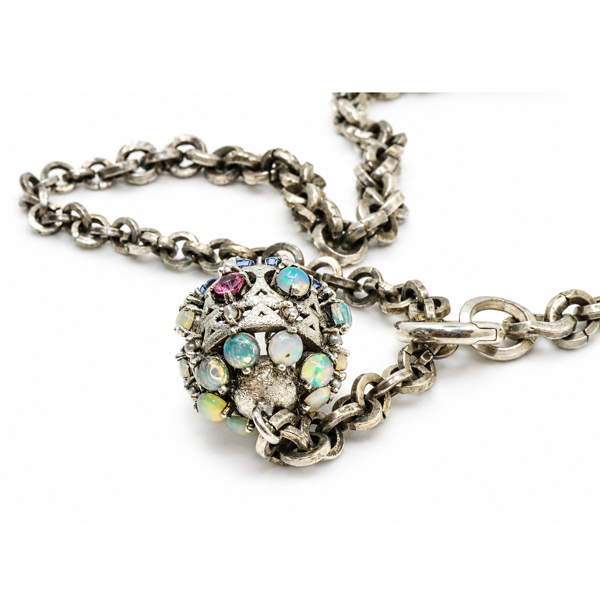
The pendant itself began as a sketch before being rendered in CAD, which De Souza uses selectively for geometric forms. Several cast components were assembled and laser-welded to create the final sphere, which is hollow—a necessary concession to wearability in a jewel designed to look impressively heavy without actually dragging its wearer toward the floor.
The chain supplies much of that sense of heft. Like the necklace itself, it wasn’t conceived all at once. De Souza, a bench jeweler by trade, had spent years experimenting with chains that felt masculine, rugged, and worn, developing versions in several different widths. For Gravity, she brought those previous experiments together into a single graduated design. “Some pieces take years to arrive,” she says. “I keep adjusting proportions, weight, texture, and construction until the piece finally feels the way I want it to feel.”
Each link begins as sterling silver square wire, individually cut and then deliberately marred with needle-nose pliers before being hammered and oxidized. De Souza wanted the finished chain to appear as though someone had “worn it to a mosh pit and maybe gotten into a fight with it.” Against all that scarred silver sit materials that could hardly feel more delicate.
Seed pearls have been part of De Souza’s visual vocabulary since childhood; her mother spoke frequently of her love for them. Opals appealed for their mystical, almost living quality, while sapphires—De Souza’s favorite stones to set—offered nearly limitless color options.
“For this piece, I really liked the contradiction between those delicate, luminous materials and the oxidized, hammered silver,” she says. “Even the tiny seed pearls catch the light in a way that feels almost tender against the roughness of the metal.”
It’s exactly that tension that makes Sanct Desiderata’s Gravity so compelling. The jewel looks tough enough to do some damage, but get close and you find tiny pearls, flashes of opal, and colored sapphires embedded throughout its surface.
And silver is hardly incidental to the effect. “I never see sterling silver as simply the obvious ‘cheaper than gold’ option,” De Souza says. “Silver has its own identity, its own atmosphere, and a kind of attitude that gold doesn’t always have.”
She calls it “a people’s metal”—one that gives her freedom to make something oversize, destroy and rebuild surfaces, and let the material change with wear. Gravity’s oxidation will gradually soften where the chain touches the body, developing a patina unique to its owner. “I like that it isn’t meant to stay frozen in one perfect state,” De Souza says. “It should continue recording wear.”
Which seems exactly right for a jewel about gravity, and the impact of what happens after it strikes.
Top: Gravity lariat in sterling silver with opals, seed pearls, and natural sapphires, $2,780; Sanct Desiderata
- Subscribe to the JCK News Daily
- Subscribe to the JCK Special Report
- Follow JCK on Instagram: @jckmagazine
- Follow JCK on X: @jckmagazine
- Follow JCK on Facebook: @jckmagazine