Social media platforms have always been a breeding ground for natural versus lab-grown diamond (LGD) debates, but recently the tone has taken a mean-spirited turn. Industry (and even nonindustry) proponents of natural diamonds are responding to pro-LGD content creators with robust arguments—as is always the case—but what feels different about the current discourse is an implicit shaming of the LGD consumer.
Comments on these types of posts deliver increasingly vicious rebukes such as “If you can’t afford big diamonds, don’t have them” or “It’s so fake—gauche people can pretend they have the money for large diamonds.” And the pile-on is largely lead by jewelry industry insiders; some of these commenters offer their opinions with thought-provoking facts, others seem singularly interested in advancing a narrative that LGDs are “the fake handbags of the jewelry industry” or “costume jewelry” or “a cheat.”
Surely there are other approaches to making the case for natural. Many industry people have reached out to me in praise of Rob Bates’ recent analysis “Lab-Grown Diamonds Are Destroying Economies. Is That Okay?” I wrote an article for the New York Times last summer about GIA’s decision to modify its grading reports for LGD. If lab reports are important to the client you’re hoping to convert, the GIA headline could be the thing that convinces them a natural diamond is the better choice.
But can the industry change the hearts and minds of young people who want to put their cash flow toward a down payment on a house instead of investing in a natural diamond? That’s an ongoing challenge. Still, I would say that maligning the jewelry customer who cannot, or does not want to, pay natural diamond prices is not the answer.
I don’t pretend to know the answer, nor do I dare posit one. Yet here’s what I do know, based on some reporting I socked away to surface at an opportune moment: If LGDs are good enough for high-net-worth customers, maybe it’s time to turn down the heat.
Just as your wealthiest customer is happy to sell off Great-Uncle Walden’s Patek Phillippe pocket watch for some “mad money” while gold prices are soaring, a LGD rivière necklace that costs 70% less than something you might see from Harry Winston or Tiffany & Co. is quite compelling to some affluent jewelry collectors. As an example, former Real Housewife (of New York) Bethenny Frankel—an entrepreneur and social media personality—seemed downright enchanted when the idea of LGD jewels was presented to her back in 2024.
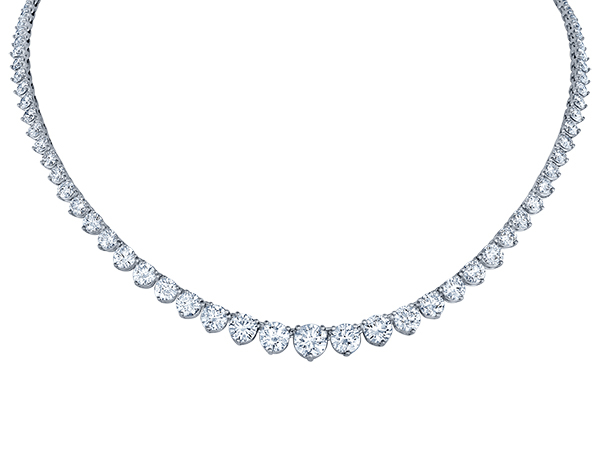
Even if you’re part of the elite, there’s got to be something undeniably satisfying about knowing your piece features LGD of such exceptional quality that a comparable version set with natural diamonds would have cost millions.
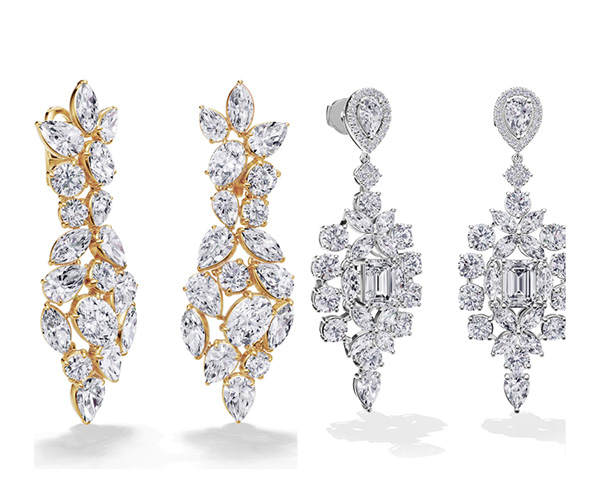
“We offer nothing less than G color and only offer VS1 or VS2 in terms of clarity,” says Akshie Jhaveri, founder and creative director of Grown Brilliance, a New York–based LGD brand that offers high jewelry pieces and has store locations in 14 top markets. “We don’t want our customers to have to compromise.”
The customer buying LGD at the five- and even six-figure level tends to be pretty savvy, so they are surely aware that lab-grown gems are more of an easy-access quick fix. They are not worried about whether their progeny will be able to cash in on the sale of their LGD rivière at Sotheby’s upon inheriting it.
“At the end of the day, you’re getting what you want,” says Lauren Grunstein, vice president of Verstolo, a jewelry company in New York City that offers both natural and LGD and specializes in bespoke pieces for private clients. “Oftentimes the savings affords the ability to buy two pieces.”
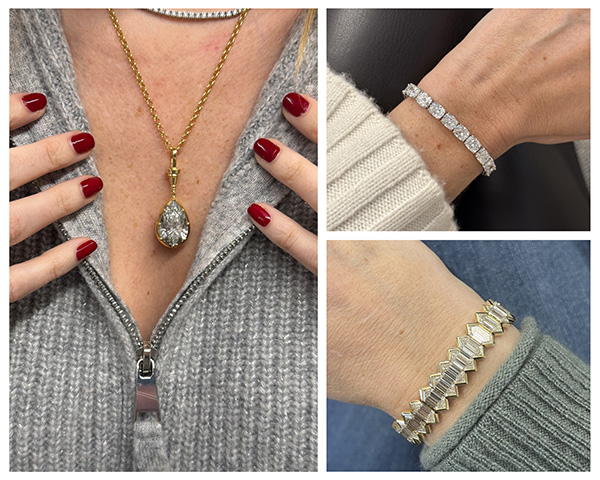
Plus, with lab-grown, “you get a lot of bang for your buck when you’re buying a major, major piece,” says Grunstein. Consider a 12 ct. tennis bracelet: Made with LGD, it would cost around $22,400; with natural diamonds, as much as twice that amount (and up into six figures from a prestigious jewelry design house).
Jhaveri agrees, especially when it comes to upgrading an existing piece in your collection, perhaps to a 20 ct. eternity band. “That’s not something most people have in their jewelry box,” she says. Likewise, you might replace your natural 1 ct. studs with much larger LGD versions (without having to worry about them attracting too much attention on the subway or in the park).
Jhaveri notes that one of Grown Brilliance’s clients recently commissioned a LGD rivière necklace totaling—wait for it—90 carats. So turning up the volume appears to be a major draw for lab-grown.
Meanwhile, “color is an area that has always been desirable in diamonds but almost not achievable or affordable, even for the uber-rich,” says Amish Shah, founder and CEO of J’evar, a New York–based LGD fine fashion jewelry brand.
Given the rarity of fancy colored diamonds, most jewelry stores likely don’t have, say, a natural blue or pink diamond eternity band at the ready. “It doesn’t exist,” Shah says. But if it did? “That would be like selling your house to buy a ring.”
Do these well-off customers and their reasons for buying lab-grown pieces deserve scorn and disgust? Or is there an opportunity to capitalize on here? I know I’m not the first to point out that high-net-worth customers who are into LGD also tend to have no shortage of natural diamonds in their collection. To them, the two types of stones are not mutually exclusive.
Which may also turn out to be the case for the customer who makes a modest LGD engagement ring purchase at 25 but upgrades to a more valuable natural stone when they make partner at their law firm a decade later.
All this to say: I’d love to see the natural diamond versus LGD issue simmer down. It saddens me that the discussions are becoming as divisive as American politics. You can lay out the facts and make all kinds of compelling cases in defense of your position, but in the end, people want what they want.
Maybe we can all agree that there is a diamond—or many, many carats of diamonds, as the case may be—for every type of customer. Because no good can come from, as a jeweler recently put it to me, “yucking someone’s yum.” Diamonds are delicious no matter how—and to whom—they’re served.
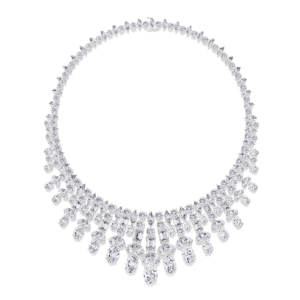
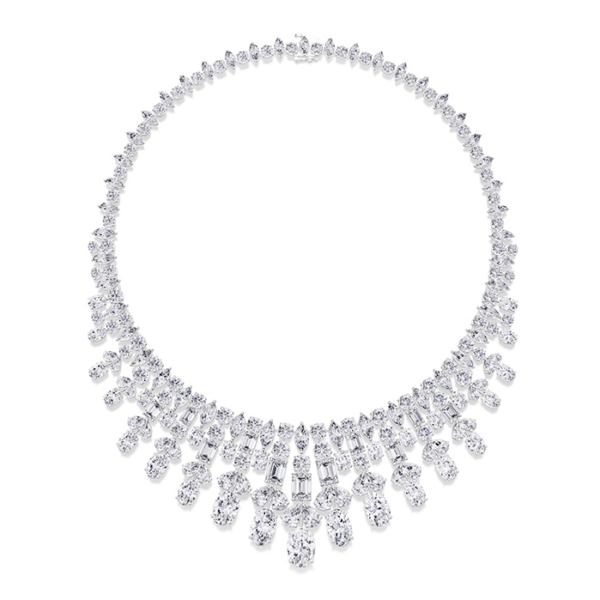
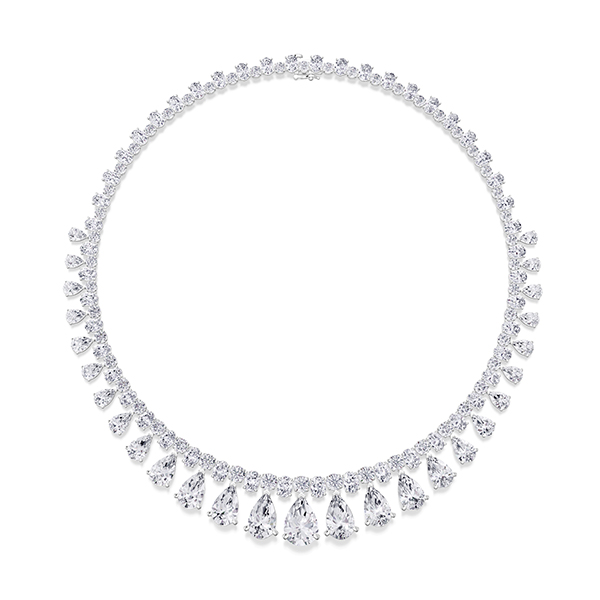
Top: Monaco necklace in 18k gold with 154.36 cts. t.w. lab-grown diamonds, $129,600; Grown Brilliance
Follow me on Instagram: @aelliott718
- Subscribe to the JCK News Daily
- Subscribe to the JCK Special Report
- Follow JCK on Instagram: @jckmagazine
- Follow JCK on X: @jckmagazine
- Follow JCK on Facebook: @jckmagazine