
The London-based jewelry designer Anabela Chan had a life-changing epiphany on a visit to the sapphire mines of Sri Lanka in 2012.
“I trained very traditionally at the Royal College of Art and had won design awards from the Gemmological Association of Great Britain,” Chan tells JCK, “but seeing the conditions of how people work, how little they were paid, and seeing the disparity in the industry—these people were mining some of the most precious commodities on the planet in some of the worst conditions—didn’t sit right with me.”
Chan returned from that trip and threw herself into researching alternative gem materials, from recycled metals to lab-grown gemstones. Her first breakthrough came in 2020, when she introduced Blooms, a fine jewelry collection featuring recycled and refined aluminum from solar cans. “The challenge was how to recycle a soda can to work for jewelry, and how to do so using techniques borrowed from the aeronautical industry.”

The effort sparked an idea to transform “waste to wonder” that culminated last month with the introduction of Fruit Gems, a collection of colorful gem materials synthesized from spinach, beetroot, blueberry, purple sweet potato, blue spirulina, green plankton, and dragon fruit.
“I was researching food waste and learned that a staggering 40% of food available to us in the West is actually discarded,” Chan says. “We love variety and the shelf life of fruit is so limited. That equals over nine tons of food in the U.K. and over 44 tons in the U.S. going to landfills. I thought, What if we could take fruits and vegetables beyond their sell-by dates and harness those elements to make a new class of gemstones made from organic matter?”

In the brand’s London workshop, Chan and her team experimented with various ways to extract the color and essence of the fruits—including crushing, grinding, simmering, air-drying and freeze-drying—to determine which one worked best. From the carotenoids in dragon fruits and tomatoes, she was able to derive red and orange; flavonoids from carrots and lemons gave her yellow; betalains from beetroot made red and purple; blue was derived from the anthocyanins in blueberries and spirulina; and chlorophyll in spinach and plankton gave her green.

Next, Chan found a way to give the Fruit Gems the right shine and luster, not to mention the durability that allows them to be cut, faceted, and polished the same way as natural gemstones, with the ability to be cast into forms like molten metals. She bonded and stabilized them with a bio-resin foundation derived from plants and renewable organic materials such as corn, soybean, agave, and avocado seeds.
Along the way, Chan also devised what she calls “Regenerative Gemstones,” created using lapidary off-cuts of gems—including rose quartz, amethyst, and lapis—that have been infused with autumn leaves and twigs, as seen in the Virosa Mushroom earrings.

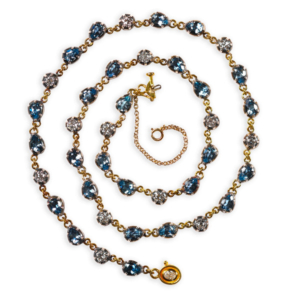
The Fruit Gems collection—which currently numbers nearly 40 pieces featuring eight different types of Fruit Gems and eight types of Regenerative Gems—features 18k gold vermeil settings and accent gems that are either lab-grown colored stones or Regenerative Gems.
For Chan, whose academic and professional background has always included a combination of art and science—she trained in architecture before going to work for Alexander McQueen, followed by a masters in goldsmithing from the Royal College of Art—Fruit Gems is the embodiment of a longstanding dream to use organic forms to create engineered elegance.
“The excitement,” she says, “is in always looking for ways to do new things.”
Top: Petunia earrings in 18k yellow gold vermeil with lab-grown and pavé-set emeralds and spirulina, $1,498; Anabela Chan
- Subscribe to the JCK News Daily
- Subscribe to the JCK Special Report
- Follow JCK on Instagram: @jckmagazine
- Follow JCK on X: @jckmagazine
- Follow JCK on Facebook: @jckmagazine