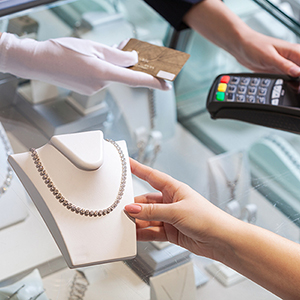
U.S. jewelry sales continued to grow in September despite soft consumer sentiment, according to Tenoris retail data, with revenue at specialty jewelers increasing 5.7% year over year.
The latest figures reinforced what Tenoris described as a pattern that’s become familiar in the jewelry market: Revenue is being supported by higher spending per-purchase even as consumers buy fewer items, particularly at lower price points.
That divergence has an important implication for retailers, Tenoris said. As demand becomes increasingly dependent on price point, the data analytics firm said jewelers need to pay closer attention to how they allocate inventory between items with high and lower value. Strong overall revenue can mask weakness in the number of pieces being sold and leave merchants overstocked in parts of the market where demand is softening.
In September, average spending per item at specialty jewelers increased 11% from a year earlier, while sales of lower-priced jewelry declined 11%. Merchandise priced above $2,500 continued to outperform less-expensive jewelry. Specialty jewelry revenue—which is up 8.5% year to date—now has increased every month since October 2024.
The split also was evident in diamonds. Sales of finished diamond jewelry slipped 0.6% after a lengthy period of mostly uninterrupted growth, while overall natural diamond jewelry sales, including loose stones, fell 1%. Consumers who did purchase diamonds spent more, however, with average spending per stone increasing 11%.
Lab-grown diamonds followed a different trajectory. Demand for jewelry set with lab-grown stones jumped nearly 26% year over year. Revenue from loose lab-grown diamonds nevertheless fell for the fifth consecutive month despite higher unit demand, reflecting continued declines in retail prices. Tenoris noted that wholesale prices have recently begun to rise, potentially easing some of that downward pressure.
Gold jewelry displayed a pattern similar to the overall market, with revenue increasing even as unit sales declined. Tenoris said the continuing divide between unit demand and revenue makes both inventory allocation and price-point management particularly important for retailers: The question is increasingly not simply whether consumers are buying jewelry, but what price levels are generating demand and which ones are losing it.
The JCK News Desk uses AI to help research and produce the first draft of articles. This story was then reviewed by staff writer David Blomquist.
(Photo: Getty Images)
- Subscribe to the JCK News Daily
- Subscribe to the JCK Special Report
- Follow JCK on Instagram: @jckmagazine
- Follow JCK on X: @jckmagazine
- Follow JCK on Facebook: @jckmagazine