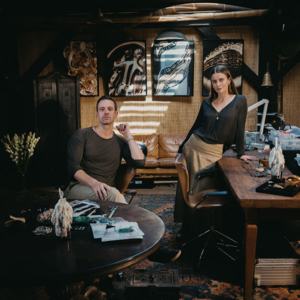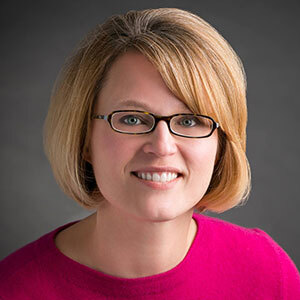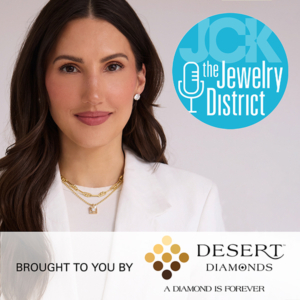
Victoria Gomelsky and Rob Bates talk to Nicole Wegman, founder and CEO of Ring Concierge, who began her career in the world of retail apparel and ended up starting a jewelry business. Nicole’s foray into the industry began with her own search for an engagement ring. Hear how she grew from taking custom appointments from the offices of her jewelry industry mentors into a retailer with a robust e-commerce site and several physical locations that proudly caters to self-purchasing women.
Watch Now
Show Notes
02:45 Nicole’s background
04:25 Ring Concierge’s origin story
10:25 The advent of the Whisper Thin ring
13:45 Her rationale on lab-grown diamonds
17:55 Going brick-and-mortar
20:20 Importance of self-purchasing women
21:55 Handling soaring gold prices
26:05 Styles that are trending
29:30 Looking to the future
Episode Credits
Hosts: Rob Bates and Victoria Gomelsky
Producer and engineer: Natalie Chomet
Editor: Riley McCaskill
Plugs: @jckmagazine; adiamondisforever.com
Episode Transcript
This transcript has been abridged and edited for clarity.
Victoria:
Hey everyone, welcome to The Jewelry District…
Rob:
How goes it?
Victoria:
It’s good. I got home from Miami. I’m home for a few days and then I’m heading to Dallas. I haven’t been to Dallas.
Rob:
It’s amazing.
Victoria:
Good! I’m going to judge the Spectrum and Cutting Edge Awards, which I haven’t done for a long time. They used to do the judging in New York. This time they’ve done it in the Dallas headquarters of the American Gem Trade Association. I’m pretty excited.
We’ve got one of the industry’s most successful retailers, started out as an e-tailer, also has a physical showroom. I’m super excited to hear about her business because she took an idea and built it from the ground up. I’m thrilled to welcome Nicole Wegman, founder and CEO of Ring Concierge. Welcome, Nicole. It’s so, nice to have you.
Nicole:
So excited to be here. Thanks, guys.
Victoria:
So, you’re in your office. I think I see midtown outside your window, is that right?
Nicole:
Yes, that’s St. Patrick’s behind us to inspire the bride. But yes, we’re in midtown Manhattan.
Rob:
Do you have a store near there or is it just an office?
Nicole:
Our main office is here as well as our bridal showroom. We have four other store locations. Two are in New York City—one in SoHo and one on upper Madison. It’s huge.
Rob:
Nice.
Victoria:
I feel like we need to work up to where you are today. Where did you grow up?
Nicole:
I’m from Rochester, New York. I grew up in a very suburban life, not surrounded by much jewelry. Then went to school for fashion. I attended Cornell and thought I wanted to be a fashion designer. Quickly realized I have no talent in design, pivoted to more of the merchandising and planning piece of fashion. Then I moved to New York City and started my career here in product development.
Victoria:
In product development in apparel?
Nicole:
Yes. I started at Macy’s, moved to Bloomingdale’s. I was always doing product development or buying, but always in apparel and accessories. Nothing to do with jewelry.
Victoria:
Did you even think about jewelry? Was that a personal interest at all?
Nicole:
As a consumer, sure, but I didn’t have any money. I wasn’t shopping fine jewelry.
I never even entertained the idea of going into the industry because I think—as you know very well—it’s a fairly closed industry because it’s so generational and it’s so family-run.
Unlike fashion where they have these big training programs and internship programs and they’re recruiting at all the schools and there’s this natural funnel for college students, that doesn’t exist in jewelry. It didn’t then and I don’t think it does now. And so, it just never even crossed my mind. I didn’t know anything about the industry or the category. I never thought I could have a career in this industry, which of course I now feel quite differently about it.
Rob:
One of the things I’ve read about—I guess you could call it your origin story—is that you were ring shopping and you had a bad experience. Do you want to tell us a bit about that and how it spurred you to where you are right now?
Nicole:
13 years ago, I was 26 and I was looking for an engagement ring. Of course, I was very involved, like most women are. And I was especially involved because that’s just how I operate.
I was going up and down the Diamond District in New York City, trying to figure out what ring I wanted. I knew nothing about diamonds. We’d never purchased anything even close to that magnitude.
And I’m coming from this world of fashion, which is very female-dominated. The leaders of the companies are often women—and the head designers, my entire buying team, and my boss. I’d always been surrounded by women because women tend to be the main consumers of these categories.
And I’m in the Diamond District looking around and noticing it’s all men. All men, and the end users of the jewelry category are primarily women. And I thought there was this big opportunity to have a female point of view in addition to somebody younger who understood the average bride because the business really started with a focus on brides.
I was the exact age and demo of a New York City bride at the time and I thought, There’s a different way to do this. It was right when e-comm was exploding for most other categories. And e-comm was hardly even considered for jewelry at that point.
I was coming from Bloomingdales.com. There was this massive focus on how to sell clothing online, because that was new back then, which it’s kind of crazy to think about. That was only 13 years ago, and now there’s no world without e-comm. And luxury didn’t touch it. Most luxury players did not have an e-comm presence. They were very against it, and jewelry fell into that category.
I was coming in with a perhaps naive mindset of what I could do in this category, but I think it really worked in my favor because it allowed me to do it very differently and disrupt how it had always been done.
Victoria:
Tell us about that first iteration of Ring Concierge. What did you want it to reflect, and how did you feel it was disruptive?
Nicole:
The first thing I did was really focus on marketing toward women. And back then, marketing was very simple. I started an Instagram account, and this was before Instagram even had business capabilities. It was truly back when we used it for personal purposes. And I just started showing myself wearing the jewelry, talking about the jewelry, educating people on what to look for in a diamond because I had taken courses at GIA.
I had worked with a couple of mentors when I left my job at Bloomingdale’s so that I knew what I was talking about. It was a lot of learn-as-you-go, quite frankly.
I flipped upside down this concept of jewelry needing to be gifted or the man is buying a ring without the woman being involved when it comes to a proposal. This “every kiss begins with K” thought process just didn’t resonate with me. And I don’t think it resonated with many women at the time. So the Instagram account exploded very organically and very early on because it was a different way to talk about this category.
Women love jewelry. We always have. It didn’t feel appropriate to be buying it for yourself. It didn’t feel appropriate to pick out your own engagement ring, go to the appointments. And I flipped it upside down because it was something that I think all these women wanted to do, but didn’t feel like they had permission to be a part of.
Victoria:
Was it exclusively bridal at that time?
Nicole:
Exclusively bridal. It started with custom engagement rings. That’s why the name is Ring Concierge. I was trying to be that concierge for couples, or if the man was coming to me without his partner, I could be the female point of view, because I do think women should always be involved when it comes to jewelry design.
It was one client at a time, diamond lineups, custom creating rings. It was almost more of a service than it was a retail business. It took a few years for that to flip and start to be more of a traditional retailer.
Rob:
Did they come in for appointments? Were they mostly local?
Nicole:
Correct. I didn’t have the budget for an office. I started the business with $2,000. I had no funding. So what I did before I started working with my first clients is, I found a few people in the industry who would understand what I was trying to do, asked them to mentor me, to teach me. I used their offices, their connections, their manufacturers.
I said, “If you let me sit in your office, you source diamonds for me, help produce these rings for me, and I will split the profits of each sale.” And that’s how I started.
So the clients would come into these different offices and I’d sit behind a desk and pretend like it was my own desk—it wasn’t. After the appointment, I’d go home back to my apartment. And that’s how I was selling in the beginning.
Rob:
You talked about introducing the female point of view and the younger person point of view. Was there anything in particular that you think struck a chord?
Nicole:
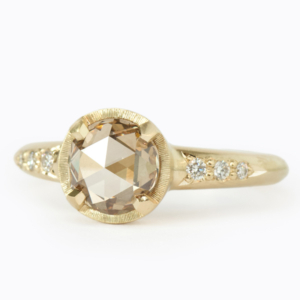
I’m coming from this world of fashion, seasonality, trends, and all these trend forecasts. I definitely applied a lot of that to the designs of the rings—knowing how to make things a little more modern, a little cooler, a little more on-trend, but still not being alienating. Because it’s an engagement ring it needs to have longevity in the design. And that really resonated with women, especially when we designed the Whisper Thin a few years into the business, which is now our most famous design.
It’s the engagement ring we’re most known for. I think anyone in the industry has heard of it at this point. And it was essentially taking a classic solitaire and making it thinner. Women wanted thinner. At the time, that was the trend: thin, thin, thin, little stacking rings. But it wasn’t easy to do because you started to risk the security and structural integrity of the ring.
So women were being told, “No, you can’t go that thin.” One client came to me and said, “Every single jeweler I’ve sat with has said they will not go thinner than 1.5 millimeters. Can you do it?” So I worked with one of my bench jewelers to figure out a way to do it and play around with proportions to get that look where it’s super-thin without messing around with structural integrity. We posted it after she got engaged and it exploded. Everybody wanted it. Celebrities wear it now. It’s still our number 1 ring so many years later.
And it came from simply really listening to the customer and instead of immediately saying “no,” saying, “well, maybe there is a way.” How can we get really innovative when it comes to product design?
Rob:
At that point, was it still in person appointments for the most part?
Nicole:
At that point, bridal was still the biggest focus of the business, but we had launched the website. The website launched, I want to say in 2017. That was based on customers asking for more giftable items from me. And I couldn’t accommodate that within their budgets through the custom process I was running for bridal. All the rings were bespoke, handmade in the Diamond District by master bench jewelers.
If you just want to buy somebody a birthday present, that’s surely not the most economical way to go about it. All of these customers were coming back saying, “I love my engagement ring,” “I love my wedding band,” “I want a tennis bracelet,” or “I want to buy my wife X-Y-Z for our second anniversary.”
So that’s when I launched the website with a much more robust price point, with products that were more of a mass production rather than being one-off bespoke pieces. And since then, that has grown tremendously. That is by far the bulk of the business today because it’s a different way of scaling. It’s women self-purchasing. It’s a repeat customer. It’s not a one-time purchase like an engagement ring is. And we can accommodate price points from under $100 to way, way up from there. So we can just reach a much bigger audience that way.
Sponsor message:
What proves natural diamonds are rare? Desert diamonds. Because just like the people we love, no two Desert diamonds are alike. They shine in sunlit whites, golden-hour champagnes, sunrise blushes…colors that are unique, special…rare. Just like the people they’re meant for. This holiday, introduce your clients to natural Desert diamonds, now in iconic pieces. A Diamond Is Forever. Visit ADiamondIsForever.com to learn more.
Victoria:
And you sell both lab and natural, correct?
Nicole:
Correct.
Victoria:
What is your view on how those categories coexist?
Nicole:
We’ve always offered both. I’ve always believed in choice. And this was before anyone was talking about lab. I would have customers come in and quietly say, “Can you get me a lab-grown diamond?” I’m talking like 2018, years ago.
Every ring was custom. Who am I to say what you should and shouldn’t make with your ring? I had customers put moissanites in $6,000 mountings. And if that’s what they want to do, because they want to put all their money into the setting and they don’t really have the budget for a big center stone right now, that’s their choice. I’m not here to judge. I’m here to create your dream ring. Lab-growns were quietly being requested for years. And they would say, “Do you think anyone’s going to know?” It wasn’t a very understood category at all.
Rob:
They wanted it because of the price?
Nicole:
The price. It was always about price. It’s still about price today. What’s changed is how loud we are and how loud consumers are about it now. Bridal exploded first when it came to lab-grown demand. Lab-grown engagement rings made up 60% of our units last year, and it’s going to be a similar number this year, so that demand is quite high.
There’s still 40% of our clients that are asking for natural. So natural is still a very powerful piece of that, but of course, lab-grown is the faster growing category.
Within fine jewelry, we held off on lab-grown for some time. There wasn’t the same level of price savings as you’d get in buying a large single diamond, which is why it made the most sense in the beginning in engagement rings.
But now that prices have adjusted to accommodate the supply—and there is a big, big price difference between natural and lab—we’ve started introducing it more and more in all the other categories, starting with diamond studs because, of course, those are still large diamonds and there’s a big savings.
Now we look at each product when we’re designing it. We price it out in both. If there’s not a huge savings to go with lab, we stick to natural because I do still really believe in natural diamonds. I think if you can get the same ring with natural for maybe only $40 more, we should be producing it with natural for our customers. But if we can produce a ring or an earring that somebody’s saving $2,000 by using a lab-grown, we’ll probably go that route.
So it is one of our fastest-growing categories, but we’re very thoughtful about when we’re providing that value to the customer versus when it just doesn’t make sense.
Rob:
Now you’re a millennial, correct? Is most of your audience millennials, and do you think they shop in perhaps a different way than older people like Victoria and myself—Gen X?
Nicole:
Yes and no. Yes, millennials are our biggest audience. I’m a millennial and that’s likely partially why I have that audience, right? You’re usually attracted to somebody who’s living a life very familiar to your own.
Gen X is the next biggest consumer base for us. Gen Z is a demographic we’re very focused on and they are certainly our brides right now, but they don’t necessarily have the same disposable income to spend on all the other categories.
If you’re buying tennis bracelets and studs, you’re probably in your 30s; You probably have eight to 12 years of your career under your belt. That’s a different level of spending. What we have found, though, is that all three generations shop online and in our store, and all three generations follow us on Instagram.
There are different ways they’re going about it when you get really specific, but we are able to reach all of them right now through our existing channels.
Rob:
At what point did you decide to go brick-and-mortar?
Nicole:
We opened our first store in 2021 down on Bleecker Street in the West Village. It was coming out of the pandemic. We had exploded during the pandemic because we were able to continue operating because we were an e-comm business.
Most of the industry, as you know, operates in brick-and-mortar. Still to this day, it’s the majority of the industry.
A lot of them had to shut down for an extended period and had a very difficult time operating in 2020. We’d had the website for many years at that point. We were very comfortable working with clients remotely for bridal. We had a very big remote base for that category from all the customers that wanted to shop with us who weren’t based in New York. So, we were able to keep going in a way most of our competition couldn’t. We took a lot of market share during that time.
Coming out of the pandemic, consumers were really craving in-person experiences. So we were bullish on retail and took advantage of a good price on a lease because commercial retail was certainly suffering. Nobody was signing leases. We were the idiots that signed a lease. And that first store crushed it. We had it for about four years, I believe.
We just switched its location last year to a bigger footprint. It had a line outside the door every day. It was doing $1,200-a-foot on average. It was a small store that made so much money because our customer wanted to experience this in real life. And that was the first time they could.
Victoria:
Any plans to expand in the West?
Nicole:
Yes, well, we are in L.A. and Florida. We are looking at an additional location for next year, somewhere in the Midwest. I’m very focused on Chicago. Who knows, might not happen, but I do think there’s a massive opportunity for us there.
We’ve tried Texas. I think we got the wrong location the first time, but I do think there’s opportunity in Texas as well. So, one or two stores next year, for sure.
Rob:
My concept of the company was that it did a lot of self-purchase. Is that a big part of your business or is it still a lot of bridal?
Nicole:
70% of the business is women self-purchasing. We’re very proud of that stat. For bridal, of course, there’s a couple involved so it doesn’t really operate that way. The majority of the business for us is e-comm in the other categories, and it’s primarily by women.
Victoria:
I had a question about self-purchase in the era of high gold prices. How has that category shifted? When I first started writing about self-purchase over the years, it tended to be $2,500, maybe $3,000, and at the higher end, a $5,000 upper price range. But what is that self-purchase category today?
Nicole:
Our number 1 category is tennis. And those are primarily self-purchases, but we sell a ton of earrings, a ton of studs. You name it, we’re selling it. It really depends on her budget and what she wants to spend.
Our average customer is spending about $1,000 on our website. So, that can get you an opening price point tennis bracelet. It could get you a variety of earrings, necklaces, and bracelets. We have over 350 styles on the website, so we certainly have a wide breadth of categories and price points for her to shop.
Victoria:
And how has the price of gold been for you?
Nicole:
It’s a nightmare, quite frankly. But what we’ve really focused on is limiting our price increases as much as humanly possible for the customer. We tried every other way possible to work on our internal expenses—negotiation with vendors, other ways to keep our costs in check—without having to raise prices.
We’ve had to raise prices. We’ve done it a few times, but we’ve done it in baby steps. We’re very thoughtful on which products. If it’s a pure gold chunky bracelet, we had no choice but to raise prices. We would have just completely lost money on it. But a product that might be more diamond-heavy, could we take a lower margin on it and keep it where it’s at so that it doesn’t become price-prohibitive?
It got tricky with our opening price-point tier because those prices all had to go up a little. Then we start to price out our opening price point customer, who we need for our new customer funnel. There are some things we kept as is. There are some loss leaders because we should be able to make a lot more margin on them, but we wanted to keep them under $500.
With gold, instead of making an appropriate margin, we’re making a lot less, but we knew we would lose that customer if we raised that price up to $800 or whatever it should be today.
Victoria:
To what degree have you used AI and how has that changed?
Nicole:
Probably like most companies right now, it’s the number 1 conversation here. Every day we’re talking about it. We’ve certainly implemented it in different areas from an operational efficiency standpoint. The finance team is using it to run reports. Our planning team is using it to project out buys. So, it is being used right now in many areas, but not enough. I’m a huge believer in it.
I think if you don’t focus on it over the next year, you’re going to be 10 years behind in two years. The companies that are going to do it are going to get really far ahead really fast. There’s a ton of savings on the back end by creating all these efficiencies.
I view it as anything we’re doing manually right now probably can be done through AI, right? If we are tracking shipments one at a time, updating our ship log, emailing the vendors to ask, “When is this coming?”—there’s probably an AI solution for it. I can’t pretend it’s something we’re going to fix tomorrow, but I know for a fact it’s possible. So, how do we chip away at these things that take the team so much time and instead allow them to focus on more strategic work? That’s where I’m hyper-focused right now.
Victoria:
I’m curious how you stay on top of trends. You came into this as somebody who was obviously very aware of seasonality and trends, as we talked about. So how are you keeping up?
Nicole:
I’ve slowly aged out of what’s cool. Ask me that 10 years ago and I would have been at the forefront of it. And now I’m so busy. I have two little kids. I can’t pretend I know what’s cool, but luckily, I have a lot of team members who are cool and keep up with that for me.
We also hired a director of merch and she’s very involved in product design. And she came from luxury. Her background is with all the coolest brands. We intentionally hired her to take that over for me. And she’s so much better at it than I am. She knows exactly what’s happening and has a pulse on everything.
But we are careful because at the end of the day, it’s fine jewelry. You need to be aware of the trends. Most of them don’t work for us. Which ones do? How do you lean into a trend but still make it really wearable and get a lot of longevity out of that item? Because it’s going to be $2,000 and you’re not spending $2,000 on something that’s out of style a year from now. So, we’re very careful about how we apply those trends in a realistic way.
Victoria:
Speaking of trends, what has been resonating with clients this season, and what are you banking on? I’d like to hear both on the bridal end and on the fashion fine end.
Nicole:
For bridal, we are seeing above all else, uniqueness. This idea of everyone having the same ring was how it operated for so many decades. It was all about the Whisper Thin the past 10 years, and it’s still wildly popular. But before that, it was a micro-pavé halo ring. There was always the ring everyone wanted.
Right now, it’s morphing into highly customized designs: diamonds that might be a little unexpected, like a champagne color, or maybe you’re going to do a marquise and set it east-west, or you’re going to have a curved, chunky mounting instead of a simple solitaire.
I think that as a result of lab-grown, where everybody was able to go bigger and whiter and better, now all your friends have a 3.5 ct. F-color oval, and that doesn’t feel so special anymore.
So what do you do to make it feel special? It can come down to the ring design. We’ve always leaned really heavily into custom. It’s something we’re fantastic at. Working with each bride to figure out how her ring can feel unique to her is what we’re seeing happening in bridal.
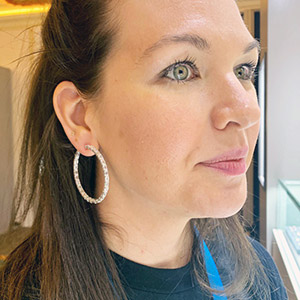
For fine jewelry and the other categories, it’s an unexpected twist on a classic—like these drop earrings that I’m wearing that have a thin huggie and a diamond drop on the bottom. We launched them in fall. They blew out immediately.
My read on that is it’s almost as classic as a stud, but there’s something interesting about it. It’s not polarizing. It’s not some fashion style that’s not going to be good in six months. But it’s also more unique than a classic stud. There’s always going to be a bigger business for a classic stud, but if you’re somebody that wants to have something a little different, this is perfect for you. So those types of products—little twists on classic—are doing really well for us right now.
Rob:
You’ve worked at Macy’s and Bloomingdale’s, and you’ve said it taught you the importance of being nimble. Now, you have 55 employees, four stores, a big e-commerce business. Is it still important to be nimble, or willing to be like, “OK, I’m in 12 meetings today and I’m not gonna be nimble?” Is that still something that’s important to you?
Nicole:
Critical. It’s the only way to survive, in my opinion. We just met today on if we’re going to change the forecast and dates for our holiday sale, which is four weeks out. And that’s not a minor thing for us to do. Our holiday sale is a massive amount of work.
We’re constantly looking at business performance trends, shifts in the market, and what’s culturally relevant all day, every day. Sometimes the team hates it, quite frankly, but I do think it’s necessary to survive, not only in this industry, but in this competitive world of retail. And that is a characteristic that I expect out of every single person that works here.
Rob:
And how do the holidays look?
Nicole:
Looking good. Like anyone in retail, you do everything you can to prepare and then you cross your fingers and all your toes and you pray to all the gods that you hit your holiday numbers because that’s your whole year.
But I do feel really good about the products we’re launching. We have a fantastic holiday collection. We’re shooting a fantastic holiday campaign. We have a really smart team that’s super-creative. So that’s all I can ask for going into a holiday season.
Victoria:
Amazing. 10 years from now, what does Ring Concierge look like?
Nicole:
I think we have a lot of opportunity to do the things we’re doing now in a bigger way. There’s massive opportunity in physical retail expansion. We know there’s massive opportunity in e-comm still. And I think there’s opportunity in category expansion, which is something we are exploring for next year in addition to the possibility of wholesale.
Any views expressed in this podcast do not reflect the opinion of JCK, its management, or its advertisers.
- Subscribe to the JCK News Daily
- Subscribe to the JCK Special Report
- Follow JCK on Instagram: @jckmagazine
- Follow JCK on X: @jckmagazine
- Follow JCK on Facebook: @jckmagazine