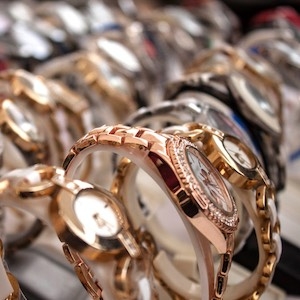
The watch industry is coping with a “perfect storm” of problems, including U.S. tariffs, the high price of gold, and a drop in demand in key markets like China, executives said at a CEO roundtable held Nov. 19 during Dubai Watch Week.
The heads of Chopard, Breitling, Audemars Piguet, and Hublot all said they were relieved by the recent announcement that U.S. tariffs on Swiss imports will be lowered from 39% to 15%.
“The uncertainty has been taken away to a certain extent,” said Karl-Friedrich Scheufele, co-president of Chopard. “Now we are looking at 15%, which is more reasonable. When is it going to be put in place, that is the question.”
Even with the tariffs, “if I look at the United States, this year our business has been quite okay—it has not been catastrophic,” Scheufele said.
Still, the watch industry has a heap of other problems on its plate, including stagnant business in major markets.
“A brand should be a plane with five engines,” said Georges Kern, CEO of Breitling. “If one engine is falling down, at least you have four others. But now there are two or three regions that are falling down.”
Audemars Piguet CEO Ilaria Resta agreed the tariff settlement doesn’t end the industry’s woes.
“It’s not only the tariffs,” she said. “It’s the price of gold, it’s the strengthening of the Swiss franc, and of course all the macro political uncertainty that surrounds us. It’s the perfect storm that we’ve been living for two years.”
Julien Tornare, CEO of Hublot, said no one is sure when the current issues will ease up.
“In the past, we experienced crises that were easier to identify,” he said. “You [would] say [that the crisis] is going to last that long, it’s going to get better.”
But now “there’s a sluggish environment,” said Tornare. “We mentioned three, four, five different factors that are affecting us [and] we don’t really know when things are going to get better.”
Despite all this, Resta argued that the “industry has proven its resiliency. The younger generations are interested in watchmaking. The average age of the first purchase is going down. We see more target clients getting interested in [watches], like women. We see geographic white spaces, like India, where the watch market is just at beginning of its journey.”
The executives all agreed that the watch industry had to reach out to the new generation, but disagreed somewhat on how to do that.
Tornare, noting that Hublot was the youngest brand at the table, said watchmakers have to be adaptable and innovative.
“In today’s world, we need to be even more agile and flexible and take opportunities when they’re coming,” he said. “I always tell my team: Go for the long term, but be ready to make some tactical moves here and there because this is how you capture new opportunities….
“[Hublot] has to continue to bring new things to the market. It’s our mission.… It’s in our DNA and where we come from.”
On the other hand, Resta asserted that new buyers aren’t looking for “newness” but “authenticity and meaningful products that have a story behind [them].
“If you look at what’s happening now in the market, the new generations to whom we should cater newness in reality, guess what? They enter the door of watchmaking through vintage….
“Your purpose, your mission, should stay true no matter what the external conditions are,” Resta added. “Very often, the mistake we do in these conditions is to change direction, and this change of direction adds on to a crisis. [Strategies] should be crisis-proofed; otherwise, they’re not good strategies.”
Kern said that selling watches was fundamentally about emotion, but there’s no magic formula for making a brand catch fire.
“If there were rules, everybody would be successful,” he said. “Thank God, there are no rules.”
The panel was moderated by Hodinkee senior business editor Andy Hoffman.
(Photo: Getty Images)
- Subscribe to the JCK News Daily
- Subscribe to the JCK Special Report
- Follow JCK on Instagram: @jckmagazine
- Follow JCK on X: @jckmagazine
- Follow JCK on Facebook: @jckmagazine